Hotel FF&E design standards translate a brand promise into repeatable spatial, product, performance, documentation, and approval requirements. They do not replace the project brief, local code review, room-specific design, supplier evidence, or current procurement data. The most reliable system connects brand requirements to area and room types, approved product families, exact supplier models and documents, project selections, quantities, revisions, quotes, and installed records.
A reusable product library sits between a static standards manual and a project FF&E schedule. It gives designers, hotel operators, procurement teams, and furnishing suppliers a controlled way to find products that have already been structured and reviewed while keeping old prices, discontinued items, local equivalents, and project customizations visible.
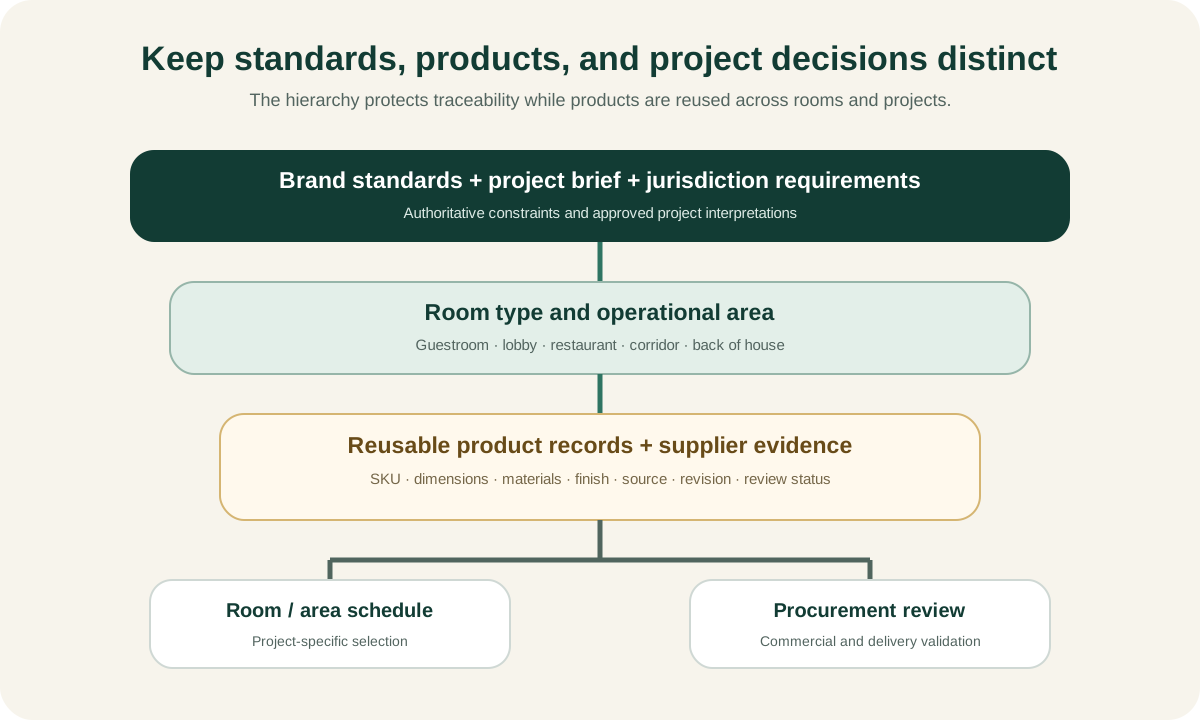
Brand Standards, Project Brief, and Product Specification
These documents answer different questions.
Brand standards define the repeatable identity and minimum or preferred requirements for a hotel flag, collection, or operating concept. They can cover guest experience, space types, finishes, signage, FF&E, OS&E, technology, operations, sustainability, accessibility coordination, and approval.
The project brief interprets the brand for one development or renovation. It adds site, market, guest profile, building constraints, room mix, operator priorities, budget, schedule, ownership decisions, local requirements, and design direction.
Room and area standards organize requirements for guestrooms, suites, corridors, lobby, food and beverage, meeting, wellness, outdoor, back-of-house, and other spaces. A prototype room or standard package may support repeated rollout.
The product specification identifies the exact item, selected option, dimensions, materials, construction, performance, documentation, supplier, quantity, location, approval, price or quote context, revision, and procurement responsibility.
The hierarchy should allow traceability in both directions. A designer should be able to see which standard drove a product field. An operator should be able to see which projects use a product that has been discontinued. A buyer should be able to see whether a quoted item is approved, alternate, local equivalent, or project-specific.
Fohlio’s article on hotel design brand standards explicitly connects standards, an FF&E/OS&E materials library, and centralized product data. It is strong competitor evidence for the topic and also confirms that private reusable libraries are not unique to Skulinker.
FF&E and OS&E Need Distinct but Connected Records
FF&E usually refers to furniture, fixtures, and equipment associated with fitting out the hotel, while OS&E refers to operating supplies and equipment used to run it. Definitions and cost treatment can vary by organization and contract, so the project should publish its own responsibility matrix.
Typical FF&E can include casegoods, seating, tables, decorative lighting, window treatments, artwork, rugs, mirrors, and selected equipment. Typical OS&E can include linens, tabletop, kitchen smallwares, housekeeping tools, guestroom accessories, and operational equipment. Some categories can move between budgets or responsibilities.
Do not rely on the acronym alone. For each category, define:
- owner, designer, operator, procurement, and installer responsibility;
- required fields and approval authority;
- brand standard or project brief reference;
- supplier documentation and sample requirements;
- budget, quote, purchase, delivery, storage, installation, and handover ownership;
- replacement, spare, maintenance, and operations data.
The distinction also affects product-library design. A lounge chair may need finish, upholstery, dimensions, construction, fire or performance documents, and installation information. A guestroom iron or tabletop item requires different operational and packaging fields.
Compare Three Information Layers
| Layer | Primary owner and purpose | Update rhythm | Facts it should contain | What it cannot do alone |
|---|---|---|---|---|
| Static brand standards document | Brand or operator defines repeatable requirements and approval rules | Formal standard releases and addenda | Principles, minimums, approved families, templates, review process | Confirm a current supplier model, project quantity, live quote, or local compliance |
| Enterprise reusable product library | Design operations, product-data, sourcing, or procurement maintains products and supplier evidence | Supplier, product, document, price-context, or approval change | Product identity, variants, supplier, attributes, documents, status, alternatives, source evidence | Replace project design, quantities, issue history, procurement transactions, or professional approval |
| Project FF&E / OS&E schedule | Project team records the approved implementation | Design, tender, procurement, construction, and handover revisions | Area, room, item code, quantity, selected option, approval, budget, quote, procurement and delivery state | Serve as a clean enterprise library without governance; remain current for future projects automatically |
A PDF can remain the issued standard while a product library provides structured references. The project schedule should cite both and add local decisions. No layer needs to pretend it owns every fact.
Build the Hotel Product-Library Schema Around Real Decisions
Identity and applicability
Record manufacturer, supplier, original model, internal product ID, category, collection, parent and variant, brand or program, hotel segment, country or region, room or area applicability, and lifecycle status.
Physical and design data
Record overall and critical dimensions, unit, materials, construction, finish, color, upholstery, hardware, mounting, electrical or plumbing interfaces where relevant, weight, maintenance, replaceable components, and available options.
Standard and approval data
Record the requirement or standard reference, approved status, approving role, approval date, conditions, sample or mock-up reference, brand-specific selection, alternate, local equivalent, exception, and superseded product.
Supplier evidence
Link the catalog or PDF page, spreadsheet row, drawing, finish data, images, sample record, warranty, care instructions, applicable test report, certificate, quotation, supplier confirmation, received date, and reviewer.
Commercial and delivery context
Record price with currency, unit, date, quantity tier, tax or freight assumptions, MOQ, lead time, incoterm when supplied, packaging, assembly, delivery constraints, installation, spare strategy, and warranty. Treat these as versioned context rather than permanent product truth.
Project usage
Record which project and area use the item, selected option, quantity, custom modification, issue or revision, approved quote, procurement status, installed substitution, and final accepted documentation.
The same schema does not need to expose every field to every user. A designer may search dimensions and finish; procurement needs supplier terms; hotel operations needs maintenance and replacements; governance users need source and approval history.
The furniture product master data guide defines the reusable product, variant, supplier offer, asset, and source-evidence layer beneath these hotel-specific approval and project fields.
Approved, Alternate, Local Equivalent, and Discontinued
Product status should communicate what decision has been made.
Approved means the item has passed a defined review for a stated program, region, or project. It does not mean every future quote, location, and installation is automatically approved.
Alternate is a different product proposed to satisfy similar requirements. Keep it as a separate identity and record which criteria match or differ.
Local equivalent can address local sourcing, lead time, logistics, availability, regulation, or cost. “Equivalent” should be supported by a comparison of dimensions, construction, performance, appearance, maintenance, warranty, evidence, and operational impact—not only a similar photograph.
Project-specific identifies a custom product or deviation accepted for one development. The decision may later inform the library but should not silently become a global standard.
Superseded and discontinued preserve history while preventing new selection. Link the replacement and explain the transition.
Use approval scope. A product can be approved for one brand program and under review for another, or approved aesthetically while technical and commercial confirmation remain open.
Prevent Old Product Data From Entering a New Hotel
Reusable data creates efficiency and risk. Before a record is reused:
- confirm manufacturer and supplier still support the model;
- verify dimensions, construction, finish codes, images, and options against a current source;
- review documents and tests for the exact product and intended jurisdiction;
- request current price, MOQ, lead time, packaging, warranty, and delivery terms;
- check the brand standard version and project-specific brief;
- verify whether a prior customization was mistaken for the standard product;
- confirm local availability, equivalent rules, and approval path;
- record the reviewer, date, evidence, and remaining questions.
Do not overwrite the old record without context. A historical product can remain valuable for replacement research or asset history. Add a current version, offer, or lifecycle state.
The same rule applies to hotel standards. A PDF with an old year in its filename may still explain design intent but should not be treated as the current binding requirement without brand confirmation. For example, Marriott’s 2023 StudioRes franchise disclosure document describes obligations to use goods that conform to applicable standards, but it does not expose every hotel’s current design manual. See the official franchise disclosure document resource as an example of primary-source commercial context, not a substitute for project standards.
Accessibility, Safety, and Professional Review
Hotel FF&E decisions interact with accessible guest rooms, routes, clear floor space, doors, controls, counters, dining, assembly areas, and other elements. In the United States, the 2010 ADA Standards for Accessible Design include requirements for places of lodging and other elements, with detailed scope and exceptions.
The product library can organize dimensions, drawings, evidence, and review state. It cannot determine that a room or hotel complies. The project team must coordinate the furnished layout, fixed elements, building systems, local accessibility, fire and life safety, electrical, structural, health, brand, and other applicable requirements.
Avoid a generic “hospitality grade” or “code compliant” field with no definition. Record the claimed standard, edition, jurisdiction, exact product or construction covered, source document, issuing party, review responsibility, and decision. Qualified professionals and the authority having jurisdiction determine applicability.
Multi-Property Rollout Without Blind Copying
Hotel groups want consistency, but consistency should apply to intent and controlled standards—not every dimension regardless of context.
Create a rollout hierarchy:
- brand experience and non-negotiable requirements;
- property type, segment, and region;
- room and area prototypes;
- approved product families and configurable options;
- alternates and local equivalents;
- property-specific deviations and approvals;
- issued project schedule and procurement;
- installed record, operations feedback, and replacement history.
When a supplier changes a model, identify all affected standards and projects. Do not automatically change issued schedules. When a property reports a maintenance problem, connect that observation to the exact product and construction before generalizing it across the library.
Cross-project data can reveal repeated products, exceptions, supplier exposure, and update work. It should not be used to claim causation without appropriate analysis.
From Supplier Catalog to Hotel FF&E Schedule
- Receive supplier catalogs, quotations, drawings, images, samples, and documents as one source package.
- Extract product candidates and keep file, page, row, supplier, and received date.
- Validate identity, dimensions, materials, finish, image, options, and commercial context.
- Map the record to a brand, area, room type, category, and requirement only after review.
- Mark proposed, approved, alternate, local equivalent, project-specific, or discontinued scope.
- Search and compare products against the project brief.
- Build a shortlist with evidence and unanswered questions.
- Promote selected products to the project FF&E or OS&E schedule.
- Add location, quantity, project finish, approval, revision, budget, and current quote.
- Complete professional, operator, brand, and authority reviews.
- Procure through controlled purchasing and track substitutions and installed state.
- Feed reusable confirmed facts and lessons back into the enterprise library.
Skulinker supports the early supplier-file, private library, search, matching, shortlist, and editable selection-plan stages. It does not replace hotel design, brand approval, complete specifications, project budget, purchase orders, logistics, ERP, Revit, or compliance review.
A Real Hotel Armchair Search With Complete Product Images
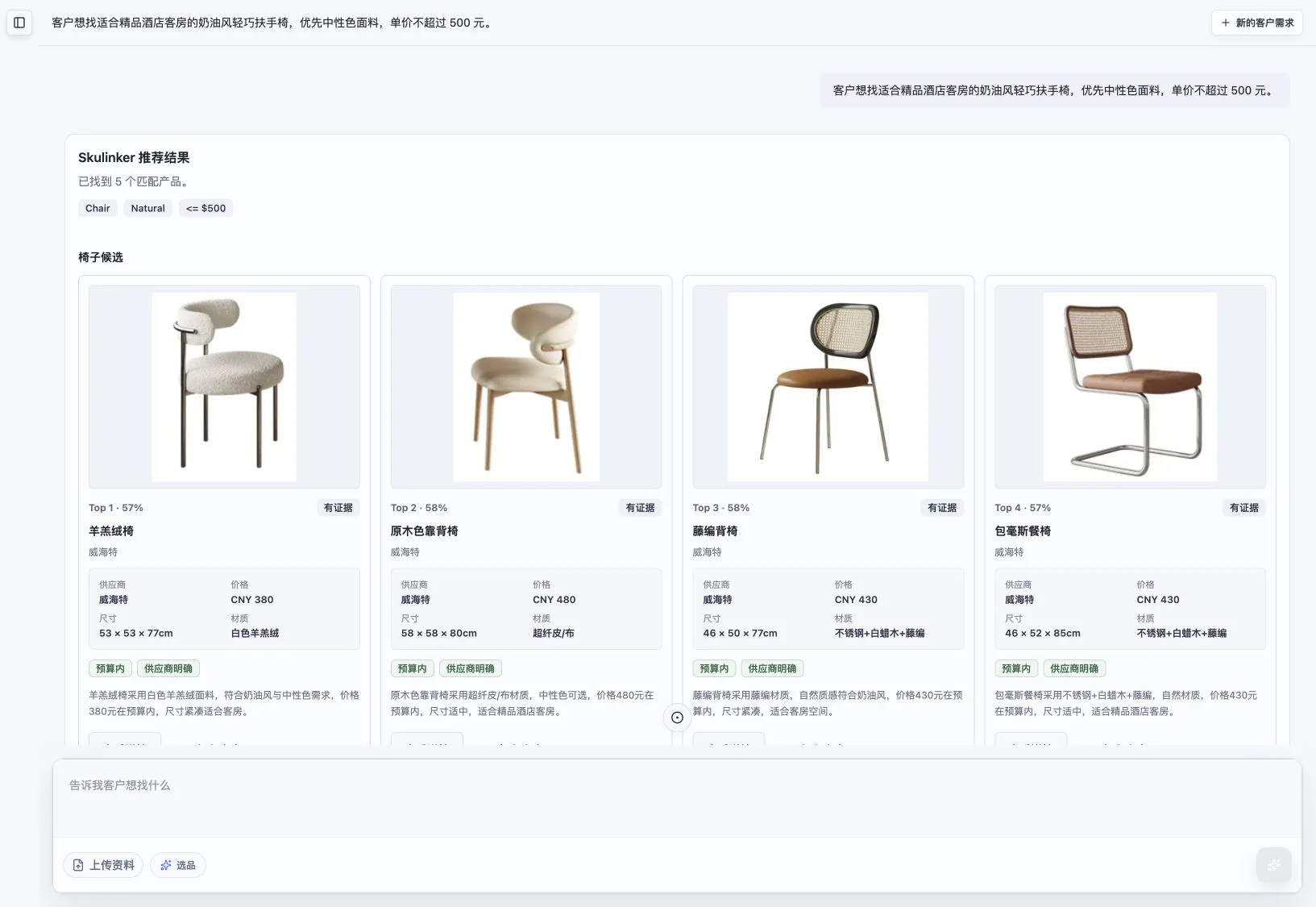
Production account test on August 4, 2026. The request asked for a lightweight, cream-style armchair for a boutique hotel guest room, with neutral upholstery and a unit price no higher than CNY 500. Skulinker returned five candidates within budget; the screenshot shows the first four, all attributed to the supplier displayed as 威海特 and priced from CNY 380 to CNY 480. The consistent preview frame and light padding keep each chair visible instead of cropping the product. “Has evidence” controls and match explanations support human review; this real output is not automatic approval or verified hotel suitability. Confirm the current source, specification, price, availability, and project requirements before selection.
Choosing the Right Software Layer
Evaluate a source-focused library when supplier files are fragmented, private products are difficult to search, and teams repeatedly rebuild the same candidate data. Evaluate complete FF&E software when the dominant need is room schedules, quantities, approvals, revisions, reports, budgeting, procurement, analytics, and BIM.
Fohlio publicly connects hotel brand standards, an internal FF&E/OS&E library, centralized data, specification, procurement, and cost management. Gather publicly provides a Resource Library, Selection Boards, specifications, revisions, budgets, and exports. Specsources publicly provides a product library, specification documents, budgets, procurement, and SpecBIM/Revit. Skulinker should be compared honestly with these broader and adjacent workflows in the furniture sourcing software guide.
The architecture may use one platform or a deliberate handoff. If two systems are used, test product IDs, variants, images, evidence, custom fields, version rules, and export ownership. Do not assume a native connector that has not been confirmed.
Frequently Asked Questions
What should hotel FF&E design standards contain?
They can define design intent, required product categories, dimensions or performance criteria, finishes, documentation, approved families, alternatives, samples, mock-ups, approval roles, and project application. The brand or operator determines the actual standard.
What is the difference between FF&E and OS&E in hotels?
FF&E generally describes furniture, fixtures, and equipment used to fit out spaces; OS&E generally describes operating supplies and equipment. Boundaries vary, so each project should publish a responsibility and budget matrix.
Can a product library enforce hotel brand standards?
It can tag approved products, required fields, scope, alternatives, evidence, and review state. Enforcement still depends on governance, project approval, current sources, professional review, and procurement controls.
How should a hotel team manage discontinued products?
Preserve the historical record, mark it discontinued or superseded, link possible replacements, assess affected standards and projects, and require review before using an alternate.
Does Skulinker replace hotel FF&E procurement software?
No. Skulinker can structure supplier files, support private product search and matching, build shortlists, and export an editable selection plan. Complete specification, budgeting, purchasing, logistics, and ERP processes remain downstream responsibilities.
Build a Reusable Library Without Losing Project Control
Use the furniture product library guide to define product records, the supplier-to-FF&E workflow to manage handoff, and the Skulinker vs Fohlio comparison to evaluate a broader hotel specification and procurement platform. Compare the evidence and professional-review model with the adjacent nursing home design guide.
Next step
Turn supplier files into records your team can review
Start with one supplier package and move through extraction, source review, matching, and selection.
Continue reading