Skulinker and Fohlio both help design and procurement teams turn product information into reusable work, but their public product scope is different. Fohlio presents a broad FF&E specification and procurement platform with an AI Product & Materials Library, reports, workflows, budgeting, analytics, and Revit integration. Skulinker concentrates on supplier PDF, Excel, catalog, and image intake, source-connected private product records, natural-language matching, shortlist creation, and editable customer selection plans.
Choose between them by testing the work that creates the most repeated effort. If the company needs formal specifications through purchasing and analytics, Fohlio publicly covers more of that lifecycle. If the first bottleneck is converting factory and supplier files into searchable products and matching those records to a customer request, Skulinker deserves evaluation. Neither conclusion requires pretending that Fohlio cannot extract data or that Skulinker is a complete FF&E suite.
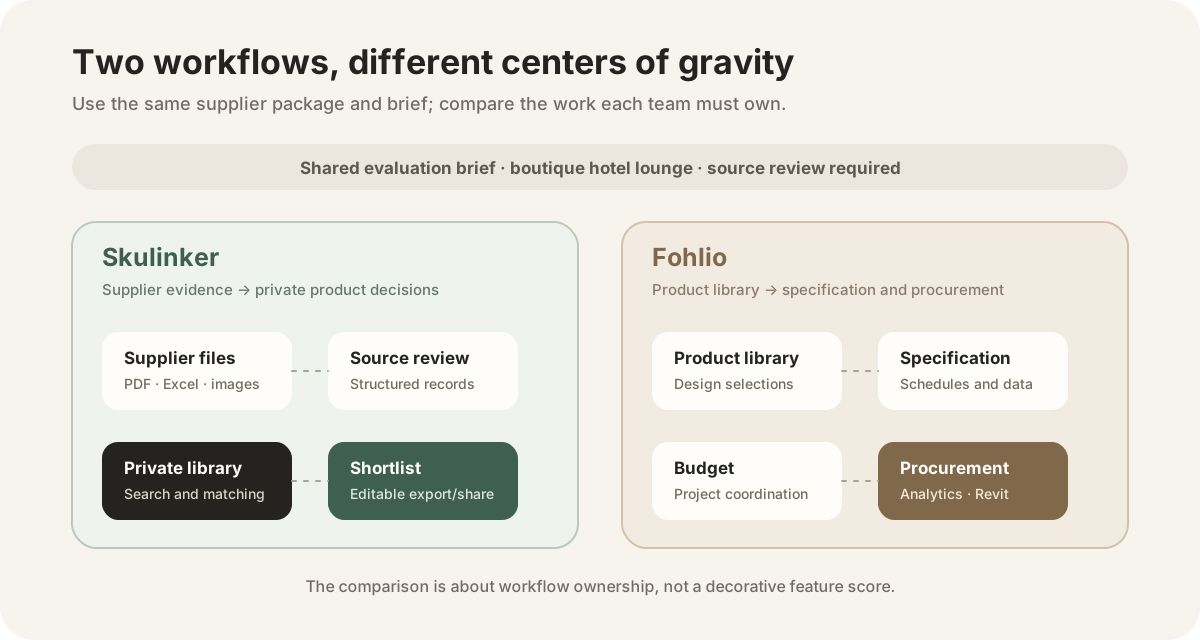
This page compares features described on the companies’ public websites, not private roadmaps or a hands-on usability benchmark. Fohlio states that its AI Product & Materials Library can extract data from PDFs or URLs and that its library supports structured imports and data mapping. Its public product pages also describe specifications, custom reports, workflows, procurement, analytics, templates, and Revit integration.
Skulinker’s implemented scope includes supplier document intake, structured extraction, source context for review, a private supplier product catalog, search and AI matching, product comparison, shortlist, and export or sharing of an editable selection plan. Skulinker does not replace formal Spec Books, complete project budgeting, purchase orders, payments, logistics, ERP transactions, PIM syndication, MDM, DAM, EDI, or Revit.
Competitor features checked on July 27, 2026. Product capabilities and pricing can change; verify current details with each vendor.
| Evaluation dimension | Skulinker | Fohlio, based on public pages |
|---|
| Primary workflow emphasis | Supplier files → structured private catalog → matching → shortlist → editable plan | Product and materials library → specification → estimating, workflows, procurement, analytics, and project delivery |
| Inputs | Supplier PDFs, Excel/CSV, catalogs, and images | PDFs, URLs, XLS/CSV/TSV/XML/JSON and other publicly described import paths |
| Product library | Private supplier product records with source context | AI Product & Materials Library with cross-project reuse and brand standards |
| Source evidence | Designed to keep extracted records connected to supplier source context for review | Public pages emphasize centralization, mapping, refresh, and imports; confirm field-level provenance needs in a demo |
| Search and matching | Private catalog search and natural-language product matching | Library filters, product discovery, workflows, analytics, and publicly described AI import capabilities |
| Shortlist / proposal | Shortlist and editable customer selection-plan export or share | Specifications, reports, templates, and other project deliverables |
| Specification | Not a complete FF&E specification or Spec Book system | Specifications, Spec Builder, custom reports, project templates, and workflows |
| Budget and procurement | Export supports handoff; not a purchase-order or budget-control replacement | Budget, cost management, quotes, procurement, and purchasing workflows are publicly described |
| BIM / Revit | No complete Revit workflow | Revit integration is publicly described |
| Best evaluation starting point | Messy supplier data and rapid customer product matching | Broad design operations from library through specification and procurement |
The table is not a quality score. A feature can exist in both products with different depth, configuration, evidence, support, and implementation effort. Test real files and a real project.
An inaccurate comparison would say that Fohlio assumes all product data is already clean. Fohlio’s current public library page describes imports from XLS, CSV, TSV, XML, JSON, and PDF, data mapping, bulk refresh, and an AI specification import path. Its homepage also says product information can be extracted from PDFs or URLs.
Skulinker also begins with imperfect supplier material, particularly furniture PDFs, Excel or CSV price sheets, catalogs, and images. The intended intake unit is a supplier package: supplier identity, document, spreadsheet, images, received date, and import job remain related while candidate products are reviewed.
The distinction to test is therefore not “can it import a PDF?” Ask instead:
- How does each platform separate products that span multiple pages?
- Can reviewers see the file, page, row, or source context behind an extracted value?
- How are images associated when filenames do not match models?
- Are original and normalized dimensions both retained?
- How are product, variant, and supplier offer separated?
- What happens when a later price sheet changes only commercial terms?
- Can uncertain records be useful for discovery without becoming approved specifications?
Use a representative supplier package in the demonstration. A clean manufacturer webpage does not test the same problem as a scanned 200-page catalog and a separate quotation.
Both platforms publicly position product data for reuse. Fohlio’s Product & Materials Library centralizes products and materials, supports imports and mapping, and connects library records to brand standards, Revit, specification, procurement, and cross-project reporting. Fohlio’s hospitality content also describes internal, pre-approved FF&E and OS&E libraries.
Skulinker builds a private supplier product library around the organization’s own source packages. The record can include supplier identity, model, category, dimensions, materials, images, price context, review state, and source evidence. Users search or describe a need, compare relevant products, and move selected items into a shortlist.
The governance questions are more important than the word “library”:
- Does a project-specific finish alter the reusable base record?
- Can an approved product be filtered separately from an unreviewed extraction?
- Does a historical catalog price remain visibly historical?
- Can a product be reused without copying an old room quantity?
- Are discontinued and alternate items represented explicitly?
- Can the organization retrieve records and supporting sources?
If the team’s main asset is a growing factory portfolio, test the full supplier update cycle. If its main asset is standardized design and procurement across projects or brands, test template, approval, reporting, and cross-project governance.
Skulinker emphasizes finding products from private supplier catalogs using structured data and natural-language requirements. A request can include product type, dimensions, material, style, budget context, or client description. Results remain candidates: the user reviews source context, compares options, adds selected items to a shortlist, and exports or shares an editable plan.
This matching flow is not the same as duplicate resolution or specification approval. Similar furniture from two suppliers remains separate. Missing certification or current price should stay visible. A match does not prove that the item complies with a project requirement.
Fohlio’s public scope emphasizes a centralized library, filtering, AI import, specification, workflow, reporting, brand standards, and analytics. Ask Fohlio to demonstrate the exact search behavior required by sales or sourcing, including natural-language needs, similar-item discovery, alternatives, and the evidence shown beside results.
Ask Skulinker to demonstrate what happens after shortlist export if the team requires controlled area schedules, revisions, estimates, purchase orders, or Revit. Those downstream requirements are where an additional platform may be necessary.
Interactive Demo in this guide
Run the same sourcing brief through Skulinker
Use a shared evaluation brief to inspect supplier intake, source evidence, matching, explicit shortlist decisions, and the boundary before formal specification work.
No sign-up required. Click the input below to try it.
Fohlio is the broader public product in these areas. Its pages describe:
- product and materials library;
- specifications, Spec Builder, and custom reports;
- repeatable project templates and estimating;
- custom workflows and collaboration;
- budget and cost management;
- supplier pricing, quotes, and procurement;
- cross-project analytics;
- Revit integration.
Feature presence does not remove the need for fit testing. A hotel operator, boutique design studio, purchasing agent, and furniture distributor can require different approvals, cost fields, document formats, and permissions. Confirm the exact modules, configuration, pricing, onboarding effort, and contract terms with Fohlio.
Skulinker’s selection-plan export can prepare reviewed candidate data for a project or customer, but it is not a replacement for those formal controls. If a team needs quantities by room, issued revisions, live budget-to-cost, quote comparison, PO processing, logistics, or Revit coordination in the same environment, that requirement weighs strongly toward Fohlio or another full FF&E platform.
Fohlio is the stronger fit to evaluate when the organization wants a broad platform spanning a product and materials library, specification, project templates, custom reports, workflows, budget, procurement, analytics, and Revit. It is especially relevant when formal project controls and multi-project operational visibility are already the primary bottleneck.
Fohlio can also be the better consolidation choice when its PDF, URL, and structured imports handle the organization’s supplier data well enough. A team should not add a separate intake product merely because it assumes Fohlio lacks import capabilities.
Run a proof that includes a supplier update, project revision, current quote, report issue, and cross-project question. Confirm permissions, implementation support, migration, data export, and the exact procurement scope.
Skulinker is the stronger fit to evaluate when the recurring pain starts with supplier PDFs, spreadsheets, catalogs, and images that are difficult to turn into reusable furniture records. It is also relevant when sales or sourcing needs to describe a customer request, find products across private suppliers, compare candidates, and prepare a customer-facing shortlist without first building a full project specification.
The source-evidence path matters when reviewers need to verify how a dimension, material, image, or price context entered the record. Teams can allow incomplete products to support internal discovery while clearly keeping them out of final quotation until reviewed.
Skulinker can also operate before a downstream FF&E or procurement system. The team must define identifiers, export fields, responsibility, and update rules. It should not be selected as a hidden substitute for missing Spec Book, budget, PO, Revit, ERP, or PIM requirements.
They can be evaluated as complementary layers when the architecture justifies two systems. A possible handoff is:
- Receive supplier PDF, Excel, catalog, and image packages in Skulinker.
- Extract and review product candidates with source context.
- Search and match the private catalog against a requirement.
- Build a shortlist and confirm the selected product and variant.
- Export the reviewed product data.
- Add area, room, quantity, project approval, specification, budget, and procurement data.
- Keep project changes and supplier master updates governed separately.
This is an architectural option, not a claim of a native connector. Skulinker does not currently promise Fohlio writeback or a prebuilt integration. The team must test available exports and its own handoff requirements.
The conceptual guide FF&E specification software vs supplier product library helps decide whether two layers are justified.
Use the same source package and project for both demonstrations:
- Can each product preserve supplier identity and source evidence?
- What happens to multi-page products, variants, and separate images?
- How is a natural-language customer request handled?
- Can users compare alternates without merging identities?
- Which fields belong to the library versus the project?
- How are revisions, budgets, quotes, and approvals controlled?
- What procurement transactions and delivery states are supported?
- How does Revit exchange work for the required roles and objects?
- Can the organization export records, images, evidence, and relationships?
- What features, services, limits, and pricing apply to the proposed plan?
Record pass, partial, unsupported, configuration required, and not tested. Avoid a decorative star rating.
It can be an alternative for teams focused on supplier-file intake, private product search, matching, shortlist, and editable selection plans. It is not a full replacement when the requirement includes Fohlio’s broader specification, budget, procurement, analytics, and Revit scope.
Fohlio publicly describes PDF and URL extraction plus several structured import formats. Confirm the exact document types, extraction behavior, evidence, limits, and commercial terms in a current demonstration.
The user label is not enough. Designers who need project specifications and procurement may prefer Fohlio’s broader scope. Designers whose main problem is organizing factory files and matching a private supplier catalog should evaluate Skulinker.
Skulinker does not currently provide a complete Revit or purchase-order workflow. Use a suitable downstream FF&E, procurement, or ERP system for those needs.
Yes. Both publicly describe reusable product data. Compare the intake sources, provenance, project controls, update governance, search behavior, and downstream deliverables rather than using library presence as the deciding feature.
Review the furniture sourcing software overview, Skulinker vs Gather, Skulinker vs Specsources, and the supplier-product-to-FF&E handoff. For the upstream workflow, inspect supplier catalog management and the AI product data extractor. Hotel teams can connect the platform comparison to hotel FF&E design standards.
Official sources reviewed: Fohlio homepage, Fohlio Product & Materials Library, and Skulinker.
Run the public Skulinker Demo
Next step
Compare products by the work your team must own
Use one supplier package and one brief to inspect intake, evidence, matching, shortlist, specification, and procurement boundaries.
Continue reading
Put this question into a fuller workflow
