
Product master data is the shared, structured record that identifies a product and describes the stable information teams need to find, compare, source, sell, and exchange it across business processes. In furniture sourcing, that record connects a product identity to its supplier, model, variants, dimensions, materials, finishes, images, commercial offers, and source evidence.
A supplier PDF or spreadsheet is not itself product master data. It is a source. Product master data begins when information from those sources is organized into defined entities and fields, with units, relationships, and provenance that another person can understand and review.
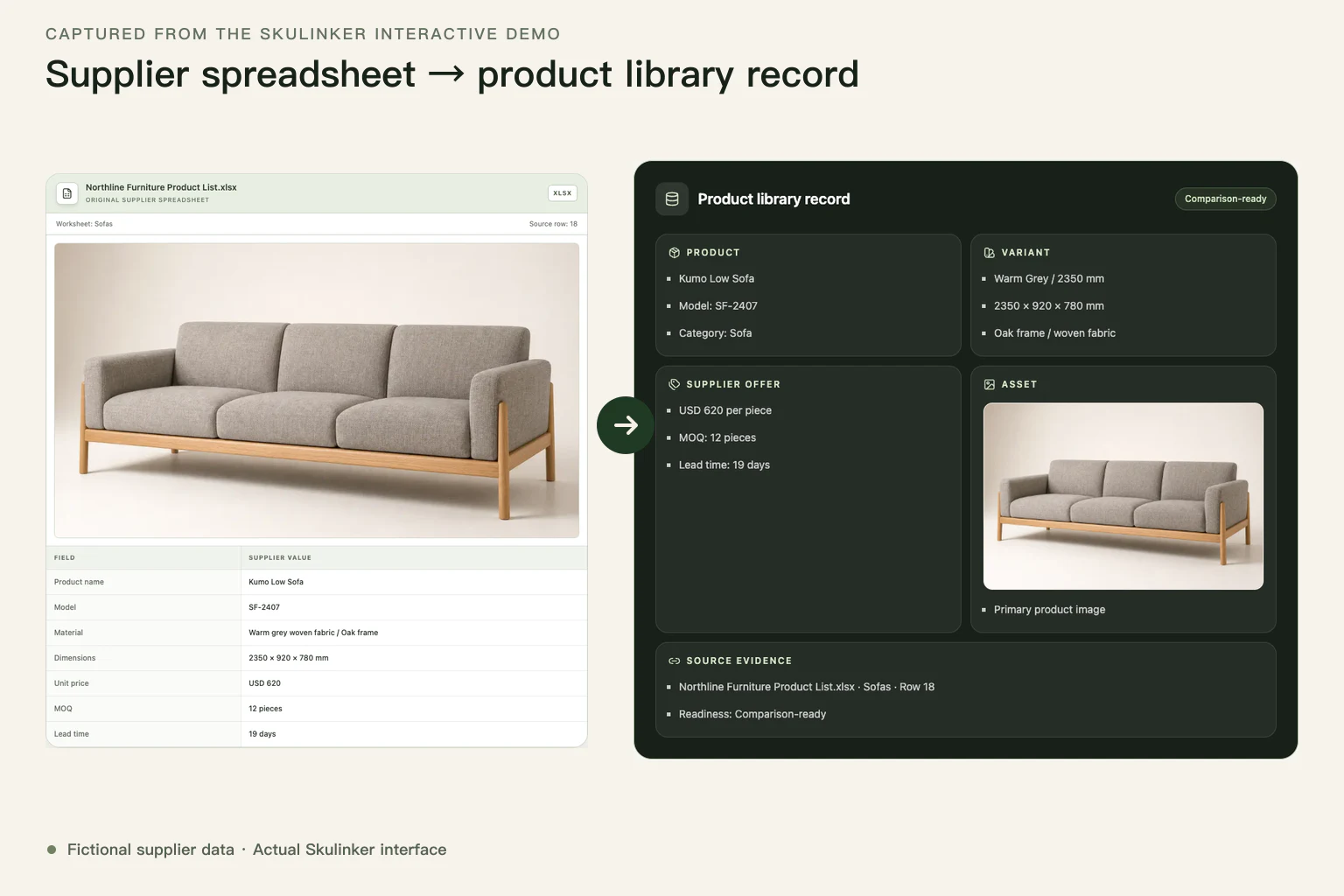
This visual uses fictional supplier data to show the difference between an incoming file and a reviewable product record.
Key takeaways
- Product master data describes the product; transactional data records events such as orders, shipments, and invoices.
- A practical furniture model separates the product, variant, supplier offer, asset, and source evidence.
- Dimensions need a dimension type and unit. Price needs a supplier, currency, basis, and effective date.
- The structured record should preserve the supplier's original values and the evidence used to interpret them.
- Product master data management is the ongoing discipline that keeps these records consistent after they are created.
What Is Product Master Data?
Product master data is the reusable information that gives a product a consistent identity and meaning across teams and systems. It commonly includes identifiers, product names, categories, specifications, relationships, lifecycle status, and the supplier or manufacturer connected to the item.
SAP's explanation of master data distinguishes core entities such as products and suppliers from transactional records such as orders and invoices. Product master data describes what the item is. An order records an event involving that item.
For a furniture sourcing team, a useful record must answer more than “What is the SKU?” It should answer:
- Which real supplier item does this record represent?
- Is it a parent product, a sellable variant, or a supplier offer?
- Which dimensions describe the assembled product, and which describe its carton?
- Which material, finish, color, and image belong to this variant?
- Where did each important value come from?
- Which commercial values are current, and when were they quoted?
These questions matter because furniture information rarely arrives as one clean row. The catalog may contain the model name, images, and overall dimensions. A quotation may contain the supplier SKU, price, MOQ, and lead time. A finish card may define codes that appear in neither file. Product master data gives those fragments a shared structure.
What Belongs in Furniture Product Master Data?
The right fields depend on the category and the decisions the record must support. A chair and a modular sofa do not need identical schemas, but they should follow the same basic field logic.
| Field group | Furniture examples | Why it needs structure |
|---|---|---|
| Identity | Internal product ID, supplier SKU, model number, parent product, variant | Prevents different items from being merged and the same item from being duplicated |
| Classification | Seating, lounge chair, dining chair, contract furniture | Supports search, comparison, rules, and downstream mapping |
| Physical specifications | Width, depth, height, seat height, weight, material, finish, upholstery | Makes attributes comparable only when meaning and units are explicit |
| Relationships | Parent product, size variant, finish option, component, collection | Preserves legitimate differences without creating disconnected records |
| Assets | Product image, dimension drawing, specification sheet, finish card | Connects media to the product or variant it actually depicts |
| Supplier offer | Supplier, currency, unit price, price basis, MOQ, lead time, quoted date | Keeps changeable commercial terms separate from the stable product identity |
| Evidence and status | Source file, page, row, original value, review state, last confirmed date | Makes the record reviewable and prevents an interpretation from appearing as source fact |
Not every field should be treated as permanent product identity. Inventory quantity, purchase orders, shipments, and invoices are transactional data. A temporary promotion is not a timeless product attribute. Channel-specific marketing titles may be enriched in a PIM, while the product master keeps the stable identity and core facts.
Product Master Data Model
A product master data model defines the entities, attributes, relationships, and rules used to represent products consistently. It is not just a spreadsheet header list. It explains what each row means and how one record relates to another.
GS1's Global Data Model implementation guidance describes foundational product attributes used through activities such as listing, ordering, moving, storing, and selling products. The exact standard used by a business may differ, but the underlying lesson is useful: identifiers, descriptions, dimensions, packaging, assets, and lifecycle information need agreed definitions.
For furniture sourcing, a practical starting model contains five connected entities:
| Entity | What one record represents | Typical fields |
|---|---|---|
| Product | The shared parent identity of a furniture design or model | Product ID, model, name, category, collection, description, lifecycle status |
| Variant | A distinct selectable configuration | Variant ID, parent product ID, size, finish, color, upholstery, variant SKU |
| Supplier offer | One supplier's commercial terms for a product or variant | Supplier, supplier SKU, currency, unit price, price basis, MOQ, lead time, date |
| Asset | A file linked to the product, variant, or offer | Asset type, file URL, viewpoint, linked record, usage rights or review status |
| Source evidence | The supplier material supporting a field or interpretation | Source file, page or sheet, row or region, original label, original value |
This separation avoids several common modeling errors. A finish change can create a variant without pretending it is an unrelated product. A new quotation can update a supplier offer without changing the chair's identity. A lifestyle image can link to a parent product, while a swatch image links to a specific finish variant.
Define fields by meaning, not only by label
Width is not sufficiently precise when one supplier means overall width and another means carton width. A strong field definition records the attribute type, numeric value, unit, and scope. For example:
dimension_type: overall_width
value: 760
unit: mm
applies_to: assembled_product
The same principle applies to price. 620 is not a reusable commercial value until the record also identifies the currency, unit basis, supplier, related variant, and quotation date.
Preserve original and normalized values
Standardization helps teams compare products, but it should not erase supplier meaning. If a source says 30 in, the model can store both the original text and a normalized value of 762 mm. If the field label is ambiguous, it should remain unconfirmed until someone resolves whether it refers to the product or its packaging.
A Furniture Product Master Data Example
The fictional example below shows one sofa represented as connected master data rather than one oversized spreadsheet row.
| Entity | Example record |
|---|---|
| Product | PRD-1048 · Kumo Low Sofa · model SF-2407 · Sofa |
| Variant | VAR-SF-2407-WG-2350 · Warm Grey / 2350 mm · 2350 × 920 × 780 mm · Oak frame / woven fabric |
| Supplier offer | Fictional Northline supplier · USD 620 per piece · MOQ 12 · lead time 19 days |
| Assets | Primary product image linked to the variant · dimension drawing linked to the product |
| Source evidence | Sample Northline catalog, page 18 · supports model, dimensions, materials, price, MOQ, and lead time · readiness: Comparison-ready |
This example is intentionally compact. A production model may add packaging, certifications, regional availability, translated descriptions, ownership, and downstream IDs. Add fields because a business process needs them, not because a supplier happened to include an extra column.
The interactive sample shows how the same record can move from a fictional supplier source to detected fields and then to a connected product master record. It does not upload a file or process real data.
From supplier spreadsheet to product library
See how Skulinker turns one fictional supplier worksheet into a reusable product library record.
Choose a step below to explore the workflow
Northline Furniture Product List.xlsx
Original supplier spreadsheet
 | |
| Field | Supplier value |
|---|---|
| Product name | Kumo Low Sofa |
| Model | SF-2407 |
| Material | Warm grey woven fabric / Oak frame |
| Dimensions | 2350 × 920 × 780 mm |
| Unit price | USD 620 |
| MOQ | 12 pieces |
| Lead time | 19 days |
Original supplier sheet
Original supplier wording
Kumo Low Sofa — SF-2407
Warm grey woven fabric · Oak frame · 2350 × 920 × 780 mm
USD 620 / piece · MOQ 12 · Lead time 19 days
Interactive Demo in this guide
Search, verify, and shortlist from a structured supplier library
Use the same sanitized homepage workflow here: describe a brief, inspect source evidence, add an item to a plan, and export a reviewable shortlist.
No sign-up required. Click the input below to try it.
- Describe the space and what you need
- Agent understanding
- Matched from the supplier file
- Details & source
- Add to plan
- Plan preview & export

Product Master Data Is Not the Same as a Supplier File
A catalog, quotation, spreadsheet, or image folder can contain product data without being a product master. Source files reflect how one supplier chose to present information at one moment. They may repeat products, omit identifiers, mix product and packaging dimensions, or place current prices in a separate document.
Turning those files into product master data requires a controlled interpretation:
- Keep related supplier files together.
- Identify products, variants, offers, assets, and evidence separately.
- Map source labels to defined fields.
- Preserve original values before normalizing units or terminology.
- Flag conflicts and missing context for review.
- Publish the structured record only for uses supported by its confirmed fields.
The supplier product data ingestion workflow explains how to organize incoming files. The AI Product Data Extractor shows the extraction layer that turns supplier PDFs, spreadsheets, catalogs, and images into candidate fields for review. The product catalog data cleaning guide covers unit conflicts, duplicates, ambiguous prices, and image assignment. Together, those steps prepare source material for a trustworthy model.
For the supplier layer around those records, use the supplier master data standardization guide. The supplier catalog management workflow then shows how reviewed records become a shared, searchable catalog for sourcing and sales.
From Product Master Data to Product Master Data Management
Product master data is the record and its structure. Product master data management is the ongoing work of defining ownership, validation, matching, approvals, change handling, and distribution across systems.
The distinction is practical. A team can design a good product data model and create useful records before it runs a company-wide MDM program. As the catalog grows, it needs decisions about who can change identity fields, how duplicates are resolved, which source wins during a conflict, and what “ready” means for search, quotation, or ERP exchange.
For those governance and workflow questions, read Product Master Data Management for Distributors. For the enrichment and channel layer, see Product Information Management for Furniture and PIM Software for Distributors.
For operating controls, pair the data quality management guide with the product data quality checklist. When approved records need to move downstream, the supplier product data ERP integration guide explains the mapping, validation, and ownership boundary.
How Furniture Sourcing Teams Can Start
Begin with one category and one real supplier package. Define the decisions the record must support before defining every possible field.
- Choose a category such as lounge chairs or dining tables.
- Define stable product and variant identity.
- List the minimum fields needed for discovery and comparison.
- Model supplier offers and source evidence separately.
- Process a small set of catalogs and quotations.
- Review ambiguity before expanding the schema.
Skulinker helps sourcing teams turn supplier materials into source-connected product records for review, private catalog search, matching, shortlist, and export. It works at the supplier-data preparation and selection layer; it does not replace enterprise governance, ERP transactions, or full channel syndication.
Teams comparing this layer with broader design and procurement tools can use the furniture sourcing software guide. For project delivery, the supplier product data to FF&E specification workflow shows where reusable product records hand off to project quantities, approvals, revisions, and procurement.
Frequently Asked Questions
What is product master data?
Product master data is the controlled, reusable information that identifies a product and describes its core attributes and relationships across business processes. For a furniture team, it can connect the internal ID, supplier model, category, variants, dimensions, materials, assets, supplier offers, lifecycle status, and evidence used to verify important values.
What is an example of product master data?
A furniture product master record might identify a lounge chair by internal product ID, supplier, model, and parent-child variant relationship. It can also store dimensions, materials, finish, linked images, lifecycle status, and source evidence. Supplier price, currency, MOQ, and lead time are better represented as a dated supplier offer connected to that product.
What is a product master data model?
A product master data model defines the entities, fields, relationships, and validation rules used to represent products consistently. For furniture sourcing, a useful model separates products, variants, supplier offers, assets, and source evidence so that a finish change, quotation update, or new image does not incorrectly change the underlying product identity.
What is the difference between product data and product master data?
Product data is any information about a product, including an unstructured sentence in a PDF or a price in a quotation. Product master data is the controlled, reusable representation of the product: defined identifiers, attributes, relationships, status, and provenance organized so teams and systems interpret the information consistently.
What is the difference between a product and a product variant?
A product represents the shared identity of a design or model. A product variant represents a distinct selectable configuration, such as one size, finish, upholstery, or pack. Separating the two keeps shared facts on the parent product while preserving the attributes, identifiers, images, and offers that apply only to one option.
Is a supplier SKU enough for a product master?
Usually not. A supplier SKU is valuable source identity, but it may be missing, reused, or changed. A resilient product master also connects the supplier, model, parent product, variant-defining attributes, and source history. The business can then maintain a stable internal ID while preserving every supplier identifier.
Is price part of product master data?
Price is often linked to the product master, but it should keep its commercial context: supplier, currency, unit basis, relevant variant, effective or quoted date, and source. Separating a supplier offer from stable identity prevents a routine price update from creating a duplicate product or overwriting historical meaning.
How is product master data different from PIM?
Product master data focuses on stable product identity, core attributes, relationships, and consistency across business processes. PIM commonly adds enriched descriptions, channel-specific content, localization, digital assets, completeness rules, approvals, and publishing. The responsibilities can exist in one platform or several systems, but ownership and handoff rules should remain explicit.
Build Structured Product Records from Supplier Sources
Clear product master data starts with a defined model and traceable source information. Use Skulinker to prepare supplier product records for review, search, comparison, shortlist, and export. Start Free
Next step
Turn supplier files into records your team can review
Start with one supplier package and move through extraction, source review, matching, and selection.
Continue reading