
What Is Product Information Management for Furniture?
Product information management gives furniture teams a governed way to define, check, approve, and reuse product records. Yet distributors often face a gap before governance begins: suppliers send PDF catalogs, XLSX price lists, specification sheets, and detached images rather than complete records. A useful intake layer must turn those files into reviewable facts without hiding their source from downstream decision-makers.
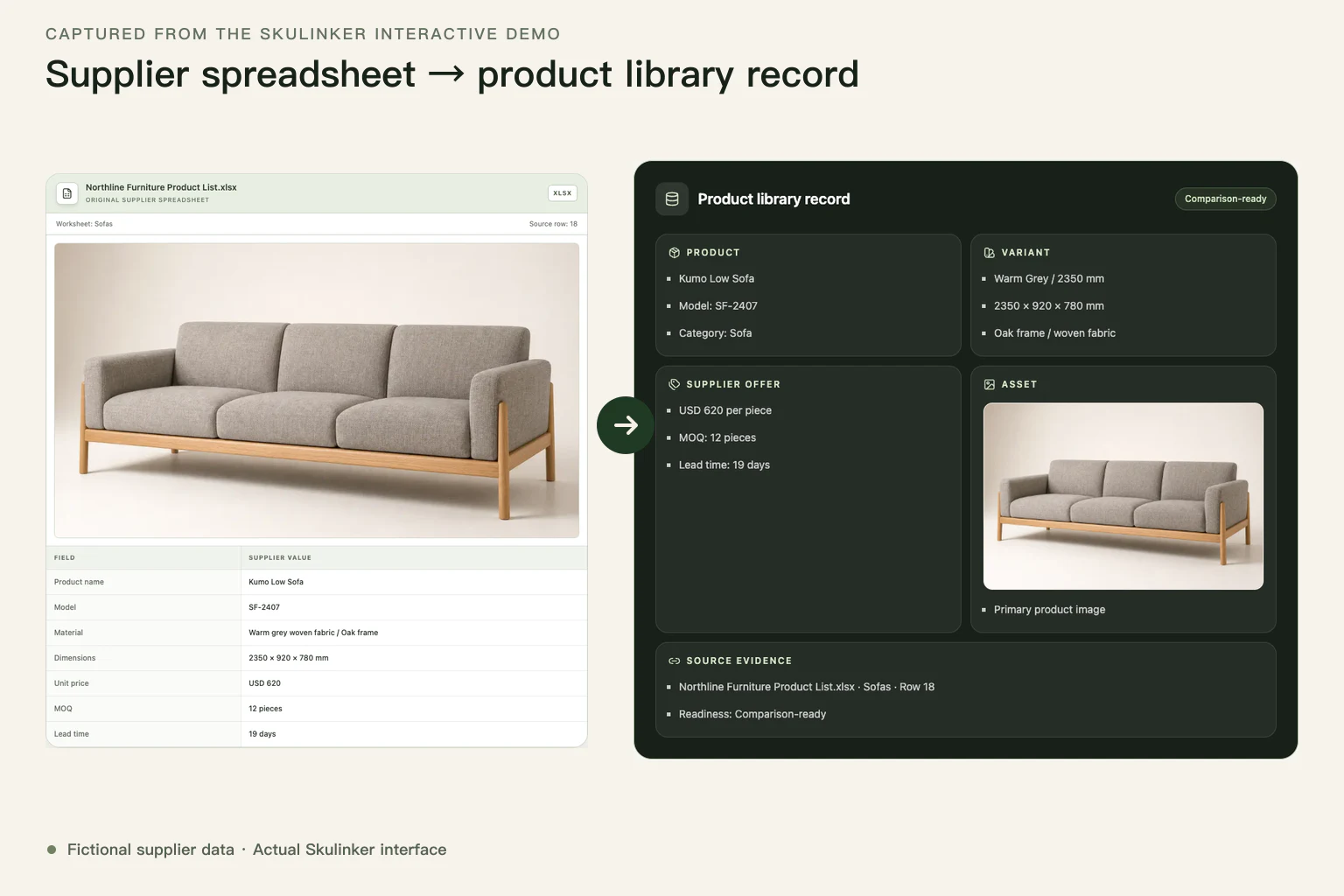
The interface is real and the supplier example is fictional. It shows why governance needs both normalized fields and the source row behind them.
What Is Product Information Management?
It is the discipline and software layer used to govern product content after a record enters the business. Teams define a taxonomy, enrich specifications and descriptions, validate required values, approve changes, and distribute controlled content. The result should be consistent enough for employees, customers, and downstream channels to understand the same item. Distribution may serve a website, printed catalog, dealer portal, or downstream data feed. Governance also makes ownership, completeness, and corrections visible instead of leaving them in private spreadsheets.
Why Furniture Supplier Files Create a PIM Intake Gap
Furniture suppliers commonly split one item across a PDF catalog, an XLSX quotation, and image folders. Names differ, variants inherit information from nearby rows, commercial terms sit in footnotes, and a new catalog may be incomplete. Two suppliers may also reuse a model number, so supplier identity must stay attached. Manual copying is slow and can detach a price or dimension from its evidence. The furniture ERP guide explains why operational systems still need dependable inputs; they cannot govern facts that were never captured.
PIM vs ERP vs MDM vs Supplier Product Data Workspace
These systems have related data, but their responsibilities and systems of record differ. IBM describes MDM as the practice of creating a trusted, consistent view of critical enterprise data. A furniture team should assign ownership deliberately; no single layer should silently become every team's authority:
| Layer | Primary responsibility | Typical system of record |
|---|---|---|
| PIM | Govern, enrich, approve, and publish product content | Approved market-facing product record |
| ERP | Run commercial and operational transactions | Orders, inventory, purchasing, and finance |
| MDM | Control shared enterprise entities and identifiers | Trusted masters across business systems |
| Intake workspace | Structure incoming files, retain evidence, and support review | Reviewed intake record before controlled handoff |
The furniture product master data model and example shows how products, variants, supplier offers, assets, and source evidence fit together. The furniture product master data management guide provides a deeper ownership model.
For a decision organized around the current bottleneck, compare PIM with supplier catalog management before assigning one system every responsibility.
Supplier PDF and Spreadsheet to PIM Workflow
A controlled intake flow is receive, extract, validate, review, publish for search, then hand off. First, keep the original file and supplier context. Extract candidate identities, attributes, terms, and images. Validate formats and flag missing or conflicting values. A person reviews uncertain records against source evidence. Approved records become searchable for sourcing and sales, while a controlled handoff prepares them for the destination system. Before handoff, map field names, units, validation status, and owners; an exported file alone does not prove that the destination accepted it. See the intake workflow and ERP mapping guide for practical details.

Editorial illustration — a visual explanation of a furniture product record, not a real customer record or product interface.
Ten Furniture Product Fields to Standardize First
The ten furniture product fields that deserve priority are supplier, SKU, model, category, variant, dimensions, material or finish, price and unit, MOQ, and lead time with its source reference:
| Field | First control to apply |
|---|---|
| Supplier, SKU, model | Preserve source identity and detect duplicates |
| Category, variant | Use a shared taxonomy without collapsing real options |
| Dimensions | Store values with units and orientation |
| Material or finish | Separate structure from surface treatment |
| Price and unit | Keep currency, basis, and effective context together |
| MOQ | Distinguish pieces, sets, cartons, and order value |
| Lead time and source | Record the stated condition and evidence location |
Reliable furniture data management starts with these controls, not polished copy. The catalog matching method shows how identity fields prevent false merges.
How AI Changes Furniture PIM Work
AI can assist with classification, field mapping, missing-value detection, unit normalization, and draft enrichment. It can also help an intake team turn supplier files into candidate records before formal governance begins. These suggestions still require source evidence, confidence handling, and an accountable reviewer; automation does not decide which fact becomes the approved record.
The practical question is therefore not whether a platform uses AI, but where AI sits in the lifecycle. AI PIM for furniture distributors should be evaluated across both the incoming supplier-data gap and the downstream requirements for completeness, DAM, localization, integrations, and channel distribution.
When You Need Full PIM Software
Choose a full platform when the business needs complex taxonomy, content enrichment, approvals, DAM, localization, completeness rules, and publishing across several channels. A formal content owner should control releases and exceptions. GS1 standards support consistent identification and exchange, while the GS1 Global Data Model describes globally consistent product attributes. PIM software for distributors becomes especially valuable when many teams and markets must maintain one approved commercial story.
When a Supplier Product Data Workspace Is Enough
A focused workspace may be enough when the immediate job is internal: discover products hidden in supplier files, compare options, preserve source evidence, prepare a shortlist, and assemble a quote. This layer helps sourcing and sales work from reviewed records before a formal system handoff. It is also practical for teams whose assortment changes faster than they can justify a broad channel-content program.
How Skulinker Fits Before or Alongside PIM
Skulinker is PIM-adjacent: it supports file intake, structure, source evidence, review, search, matching, shortlists, and PDF, PNG, or XLSX export. Skulinker does not replace full PIM, DAM, ERP, or MDM. Skulinker does not provide channel distribution or syndication, localization and enrichment governance, or connectors. Skulinker does not write to ERP or provide real-time or API integrations, EDI services, or planning.
Furniture PIM FAQ
Is product information management the same as ERP?
No. PIM governs reusable product content; ERP runs transactions. A controlled handoff connects owners without merging responsibilities.
Does every distributor need a full platform?
No. Internal discovery and quoting may need a focused workspace; multi-market enrichment and publishing justify a broader platform.
What should the team fix first?
Fix identity, units, commercial terms, and source traceability before descriptions. Reviewers then have a clear basis for correction.
Start with one representative supplier file, measure review effort, and define the destination owner before scaling the workflow.
Next step
Decide what belongs before and inside your PIM
Follow one supplier package from source evidence and review to the controlled handoff owned by a PIM or ERP team.
Continue reading