AI PIM and supplier catalog management solve different parts of a distributor's product data lifecycle. Supplier catalog management starts when vendors send PDFs, quotations, spreadsheets, and images. A full platform usually becomes essential after the company has reliable records that need governance, enrichment, DAM, and distribution.
Quick verdict: If products are stuck in supplier files, fix intake and internal discovery first. If approved records already exist but channels disagree, prioritize governed content and distribution. If both problems are real, connect the two layers with an explicit quality gate and owner.
The right choice depends less on the software label than on where product information currently stops moving.
The furniture product information management guide explains the broader ownership boundary across PIM, ERP, MDM, and the supplier-data intake workspace. The AI PIM for Furniture Distributors page then focuses on the downstream governance and channel requirements that appear after supplier records are ready to review.
AI PIM and Supplier Catalog Management Compared
| Area | Supplier catalog management | Full PIM |
|---|---|---|
| Primary input | Supplier files and private catalogs | Structured product records |
| Main objective | Extract, validate, normalize, and make products discoverable | Govern, enrich, and distribute product content |
| Typical users | Sourcing, purchasing, sales, product operations | Product, ecommerce, marketing, localization, IT |
| Source evidence | File, page, row, image, supplier context | Often managed as references or upstream integrations |
| Commercial fields | Supplier price, currency, unit, MOQ, lead time | Can govern fields but may depend on ERP or upstream sources |
| Output | Searchable internal catalog, shortlist, editable quote, mapped export | Channel-ready content, feeds, APIs, completeness workflows |
| Common integrations | ERP, PIM, quotation workflow | ERP, DAM, ecommerce, marketplaces, data pools |
The categories overlap. Some PIM platforms offer supplier portals or onboarding modules, and some catalog tools export to multiple systems. The distinction is useful because it identifies the operational starting point.
Choose Supplier Catalog Management When Intake Is the Bottleneck
Supplier catalog management should be the first priority when:
- New supplier products remain in email, shared drives, or chat attachments.
- ERP entry covers only a small part of the available catalog.
- Sales asks sourcing to search the same files for every customer request.
- Product images, prices, and specifications live in separate documents.
- The team needs source-linked review before information enters a formal system.
- Quotations are rebuilt manually from original supplier files.
In this situation, adding more publishing fields does not solve the missing-record problem. The company first needs a repeatable path from supplier package to searchable record.
Choose Full AI PIM When Governance and Distribution Are the Bottleneck
A full PIM becomes more important when:
- Product records already exist but descriptions or specifications differ across channels.
- Multiple teams need controlled approvals, versions, localization, and taxonomy.
- Ecommerce sites, marketplaces, retailers, or dealer portals require different outputs.
- Completeness rules and publication status must be governed centrally.
- Digital assets and usage rights need DAM integration.
- External channel syndication is a core operating requirement.
A PIM can become the governed source for publishable product content. It is not automatically the best interface for interpreting every supplier PDF or matching an image folder to a quotation. AI assistance can accelerate classification or enrichment, but reviewers still need traceability, approval rules, and clear ownership.
Use Both When the Lifecycle Has Two Bottlenecks
Many distributors need both layers. A practical architecture is:
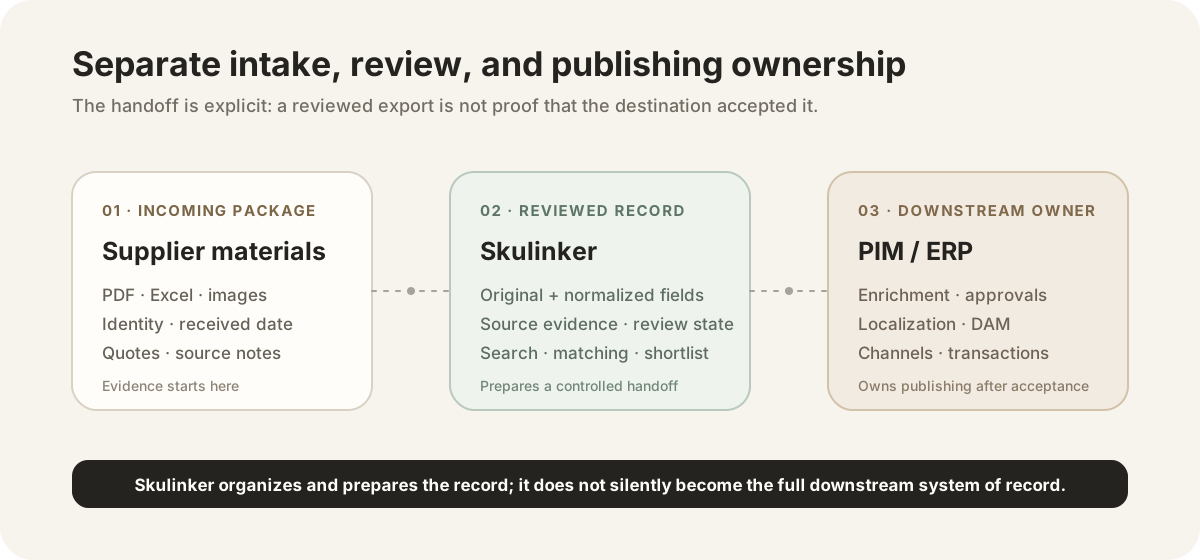
The handoff is explicit: supplier files and source review happen upstream; a PIM or ERP owner accepts only records that meet its field contract.
- Sourcing uploads supplier catalogs, price sheets, specifications, and images.
- An intake workflow extracts products, validates critical fields, and keeps source evidence.
- Approved records become searchable for sales and can support shortlists or quotations.
- Records that meet the required gate are mapped to the ERP or PIM.
- The PIM manages enrichment, approval, localization, DAM, and channel output.
This prevents the PIM from containing only the products someone had time to enter, while still protecting external channels from incomplete supplier data.
Decision Checklist
Answer these questions with the people who receive, use, and publish product data:
- Where do new supplier products wait today: inbox, drive, spreadsheet, ERP, or PIM?
- Can sales find products that have not yet been entered into the ERP?
- Are prices, images, specifications, and variants joined into one record?
- Does each critical value retain its supplier and source evidence?
- Is the primary output an internal search result, a quotation, or channel content?
- Which fields must be approved before internal discovery, quotation, ERP entry, and publication?
- Do you need localization, DAM, retailer templates, or channel syndication now?
- Who owns supplier terms, taxonomy, descriptions, images, and system mappings?
If the first four questions expose the biggest gaps, start with supplier catalog management. If channel consistency and governance dominate, prioritize full PIM. If both groups matter, design the handoff rather than forcing one system to impersonate the other.
Where Skulinker Fits
Skulinker handles supplier file intake, source-linked extraction, review, normalization, internal product search, comparison, shortlist, and editable quotation output. It can prepare records for a PIM or ERP, but it does not replace full PIM governance, DAM, channel syndication, inventory, purchasing, or finance.
Next step
Test the intake bottleneck before choosing a system label
Use one supplier package to check extraction, evidence, review and handoff separately from downstream PIM governance.
Continue reading