Product information management is the practice of maintaining product data so it can be trusted and reused across teams and channels. For distributors, the work has two distinct parts: turning incoming supplier files into reliable records, then governing and distributing the approved product information.
Treating these as one step hides the real bottleneck. A PIM cannot govern a product that is still an unreviewed row in a supplier quotation or a photo with a model number in its filename.
The furniture product information management guide defines where the intake workspace, PIM, ERP, and MDM responsibilities meet.
Map the Product Data Lifecycle
A useful product information management process follows the data from source to use:
- Supplier intake: receive catalogs, spreadsheets, quotes, specifications, and images.
- Extraction: identify products, variants, attributes, images, and commercial terms.
- Validation: check values against source evidence and resolve ambiguous identities.
- Normalization: align units, categories, materials, and shared field names.
- Governance: apply ownership, approval, completeness, version, and quality rules.
- Distribution: send approved information to ERP, ecommerce, dealer, or print channels.
- Feedback: correct records when sourcing, sales, customers, or channels find an issue.
The first four steps are often missing from PIM buying discussions, but they determine the quality of everything downstream.
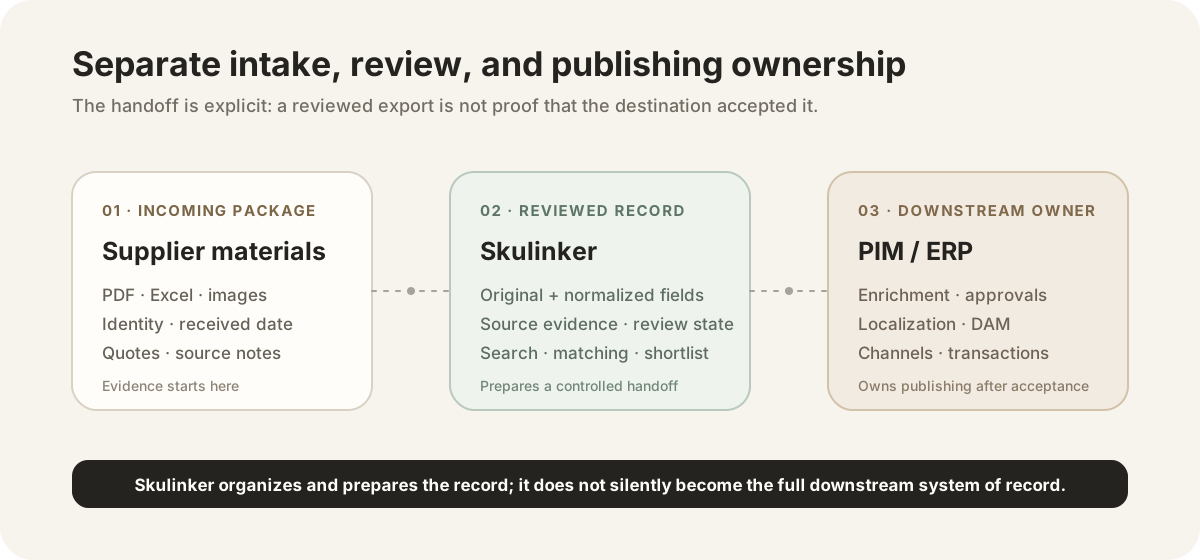
A controlled handoff names the owner and acceptance gate; an exported record does not prove that the destination system accepted it.
Define a Minimum Reliable Product Record
Do not begin by modeling every field in every supplier catalog. Start with the fields needed to identify, find, compare, and trace a product:
- Supplier, original SKU or model, product name, and variant.
- Category, dimensions, material, finish, color, and style.
- Price, currency, unit, MOQ, lead time, and effective date.
- Product image, source document, page or row, and review status.
Add category-specific fields after the shared record works. Packaging details may be critical for import operations, while fabric grades or fire ratings may matter for a contract furniture team.
Set Ownership at the Field and Workflow Level
Sourcing should own supplier identity and commercial confirmation. Product or category teams should own classification and variant structure. Sales should define the search fields required to answer customer requests. Operations or IT should own downstream PIM and ERP mappings.
An exception should always have a reason and owner. “Needs review” is too vague; “currency missing from price sheet” or “image may belong to two variants” can be resolved.
Understand the Full PIM Boundary
Full PIM software often includes workflow governance, product completeness, localization, taxonomy, channel syndication, APIs, and connections to DAM. Some products also manage digital shelf content, retailer templates, or marketplace requirements.
Skulinker does not replace those full PIM capabilities. It handles supplier file intake, structuring, source-linked review, internal discovery, comparison, shortlist, and editable quotation output. It can prepare cleaner records for a PIM or provide a focused product library when a distributor does not yet need broad channel distribution.
Select the Right System for the Current Bottleneck
| Current problem | Primary capability to prioritize |
|---|---|
| Supplier products remain in PDFs and Excel | Extraction, validation, and source-linked intake |
| Sales cannot find products not entered in ERP | Searchable private supplier product library |
| Product content differs across ecommerce channels | Full PIM governance and channel syndication |
| Images and rights are difficult to control | DAM or PIM-DAM integration |
| Orders, stock, purchasing, and finance are disconnected | ERP integration and transaction processes |
The system choice should follow the bottleneck. Buying a large publishing platform does not by itself reduce the daily work of interpreting inconsistent supplier files.
Use Quality Gates Before Distribution
Define readiness by use. A discoverable record may be enough for internal sales search. A quote-ready record needs verified price, currency, unit, MOQ, and lead time. A channel-ready record may also require approved descriptions, image rights, taxonomy, and localization.
These gates prevent teams from blocking all discovery until every field is perfect, while still protecting customer-facing and transactional uses from incomplete data.
Next step
Start with the bottleneck your team can name
Separate file intake, source review, PIM governance and channel publishing before evaluating a platform.
Continue reading