Product data matching is the process of deciding whether two product records represent the same item, a variant, a substitute, or unrelated products. In supplier catalogs, data matching must work with inconsistent SKUs, descriptions, units, images, and incomplete attributes while avoiding merges that erase commercially important differences.
This guide is for marketplace, distributor, sourcing, and catalog teams that need to match products across supplier files. It explains exact, rule-based, fuzzy, attribute, semantic, and image-assisted methods; precision and recall; review thresholds; and the source evidence needed for responsible decisions.
Quick answer: use strong identifiers when they are trustworthy, combine multiple signals when they are not, keep duplicate detection separate from similarity search, and require human review before high-impact uncertain matches change a product record or quotation.
In this guide
- What product data matching means
- Six matching methods
- Precision and recall
- Duplicate, variant, offer, or substitute
- An evidence-led workflow
- Human review rules
What Is Product Data Matching?
Data matching identifies and links records that may refer to the same real-world entity. Product data matching applies that task to product identity, variants, offers, and comparable items.
Product matching is harder than comparing names. CH-102 Walnut and CH102/WN may be the same chair, but CH-102 Black may be a legitimate finish variant. Two visually similar lounge chairs from different suppliers may be substitutes rather than duplicates.
Standards help when they are present. The GS1 GTIN Management Standard defines when a trade item needs a new GTIN. The Google Merchant Center product data specification shows how identifiers and structured attributes are used to describe product offers. Supplier catalogs, however, often arrive without a complete shared identifier system.
Six Product Data Matching Methods
| Method | Signal | Good use | Main risk |
|---|---|---|---|
| Exact matching | Same trusted SKU, GTIN, or normalized key | High-confidence known identifiers | Source identifiers may be missing, reused, or typed incorrectly |
| Rule-based matching | Required agreement across selected fields | Category-specific identity rules | Rules can become brittle across suppliers |
| Fuzzy text matching | Similar names, models, and descriptions | Spelling, punctuation, and abbreviation differences | Similar wording does not prove identity |
| Attribute matching | Dimensions, material, finish, pack, specifications | Products with comparable structured fields | Missing or mislabeled attributes distort the score |
| Semantic matching | Meaning of descriptions and buyer needs | Search for substitutes and relevant options | Relevance can be mistaken for duplicate identity |
| Image-assisted matching | Visual similarity or shared product imagery | Catalogs with weak text identifiers | Same-looking products can have different construction or terms |
Most practical workflows combine methods. Exact identifiers can create high-confidence candidates, attributes can confirm or reject them, and semantic or image signals can improve discovery without being allowed to merge records automatically.
Precision and Recall in Product Matching
Precision asks: of the records labeled as matches, how many are correct? High precision limits false positives—the dangerous case where different products are treated as the same.
Recall asks: of all real matches, how many did the system find? High recall limits false negatives—the case where genuine duplicates or corresponding offers remain disconnected.
Increasing recall can lower precision if the threshold becomes too permissive. The correct balance depends on the action:
| Action | Preferred bias | Reason |
|---|---|---|
| Suggest similar products to a salesperson | Higher recall | Missing a possible option is usually recoverable |
| Merge duplicate product identities | Higher precision | A false merge can corrupt history and downstream systems |
| Compare supplier offers | Balanced with review | The team needs coverage but must confirm identity and commercial scope |
| Attach an image to a product | Higher precision | A wrong image can mislead a customer even when other fields are correct |
Do not publish a universal “safe threshold” without testing category data and consequences. A threshold is an operating choice, not a fact about every catalog.
Duplicate, Variant, Offer, or Substitute?
| Relationship | Meaning | Example | Record treatment |
|---|---|---|---|
| Duplicate | Two records represent the same supplier product identity | Same supplier and model imported from catalog and quotation | Consolidate only after evidence review |
| Variant | Products share a parent but differ in a controlled way | Same chair model in walnut and black finishes | Keep separate variant identity and parent relationship |
| Offer | Commercial terms for a product from a supplier or date | New price sheet for the same model | Keep product identity; version or attach terms |
| Substitute | Different products can satisfy a similar need | Comparable armchairs from two suppliers | Keep separate and express similarity in search |
| Unrelated | Similar signal is accidental or insufficient | Same number appears in a dimension and a model code | Reject the candidate |
This classification prevents one matching engine from doing several incompatible jobs. Duplicate resolution changes identity; semantic search and substitute discovery should not.
An Evidence-Led Product Matching Workflow
- Preserve the supplier files. Keep the catalog, quotation, images, supplier, and received date in one intake context.
- Normalize comparison fields. Align approved units and labels while retaining original values.
- Generate candidates. Use trusted identifiers first, then category rules, text, attributes, semantic meaning, and images as appropriate.
- Explain each signal. Show which fields agreed, conflicted, or were missing rather than exposing only one score.
- Classify the intended relationship. Decide whether the task is duplicate, variant, offer, or substitute matching.
- Apply action-specific thresholds. Discovery can show broader candidates; identity merges need stronger evidence.
- Route uncertain high-impact results to human review. Show source evidence beside the candidate.
- Record the decision. Store the accepted relationship, reviewer, date, and reason so future updates do not repeat the same ambiguity.
Before matching, use product catalog data cleaning to resolve obvious unit, SKU, and source problems. The find-product page explains how matching and natural-language product discovery support sales without rewriting product identity.
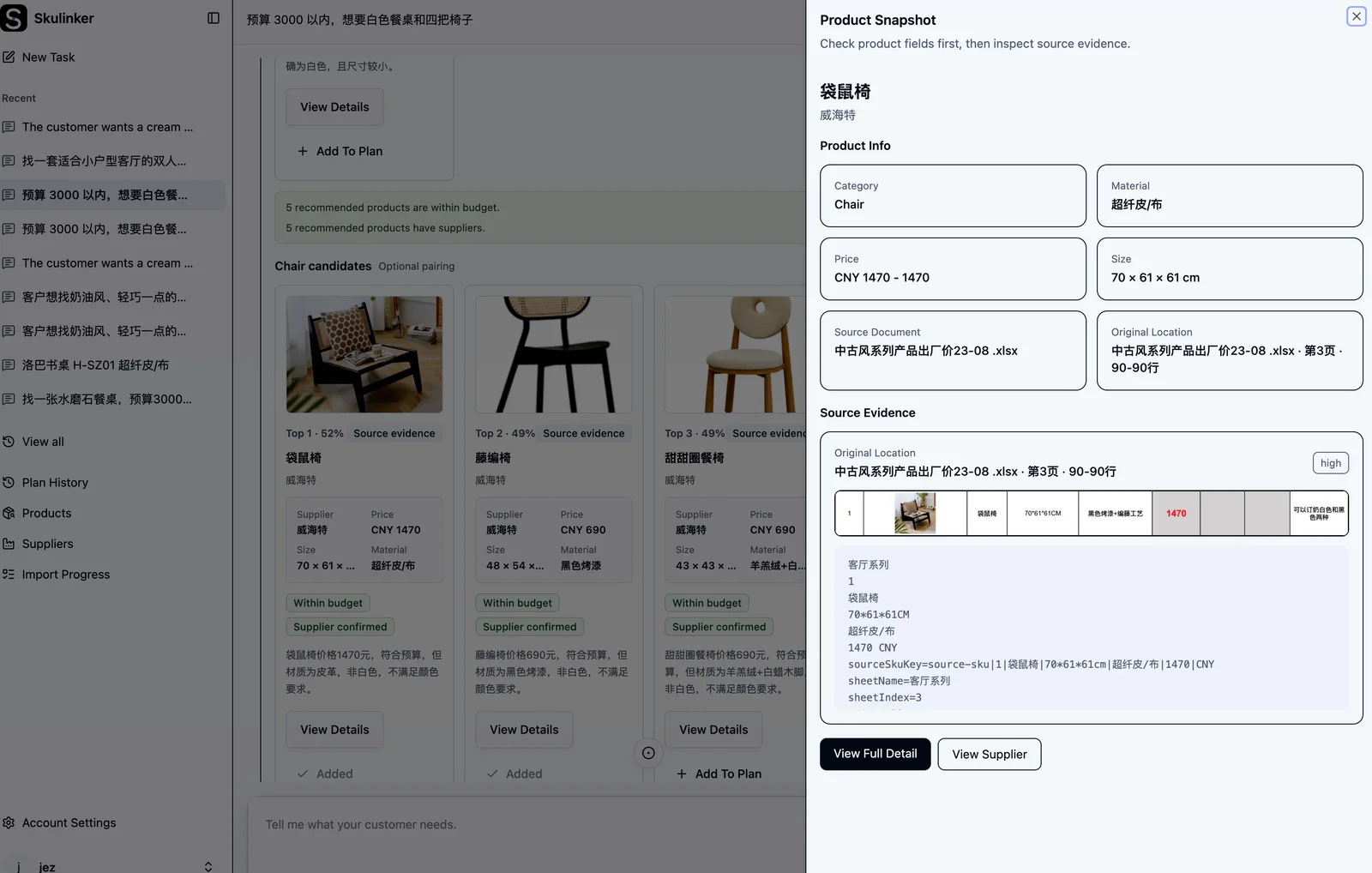
This real evidence drawer demonstrates why a match needs more than a score. The reviewer can compare the candidate against its image, dimensions, material, price context, source document, and original location before making a relationship decision.
Matching Supplier Catalogs with Missing Fields
Missing data should reduce certainty, not silently become a mismatch. If two products share a model and dimensions but one source omits material, the result may remain a candidate. If both model and dimensions conflict, a similar image should not override those contradictions without review.
Useful handling states include:
- Confirmed: strong identity evidence agrees and no material conflict remains.
- Likely: several signals agree, but one important field or source is missing.
- Possible: enough relevance exists to show the candidate for discovery.
- Rejected: identity evidence conflicts or the relationship was evaluated and ruled out.
- Needs review: the consequence is high or source evidence remains ambiguous.
These labels communicate uncertainty more honestly than a precise-looking score with no explanation.
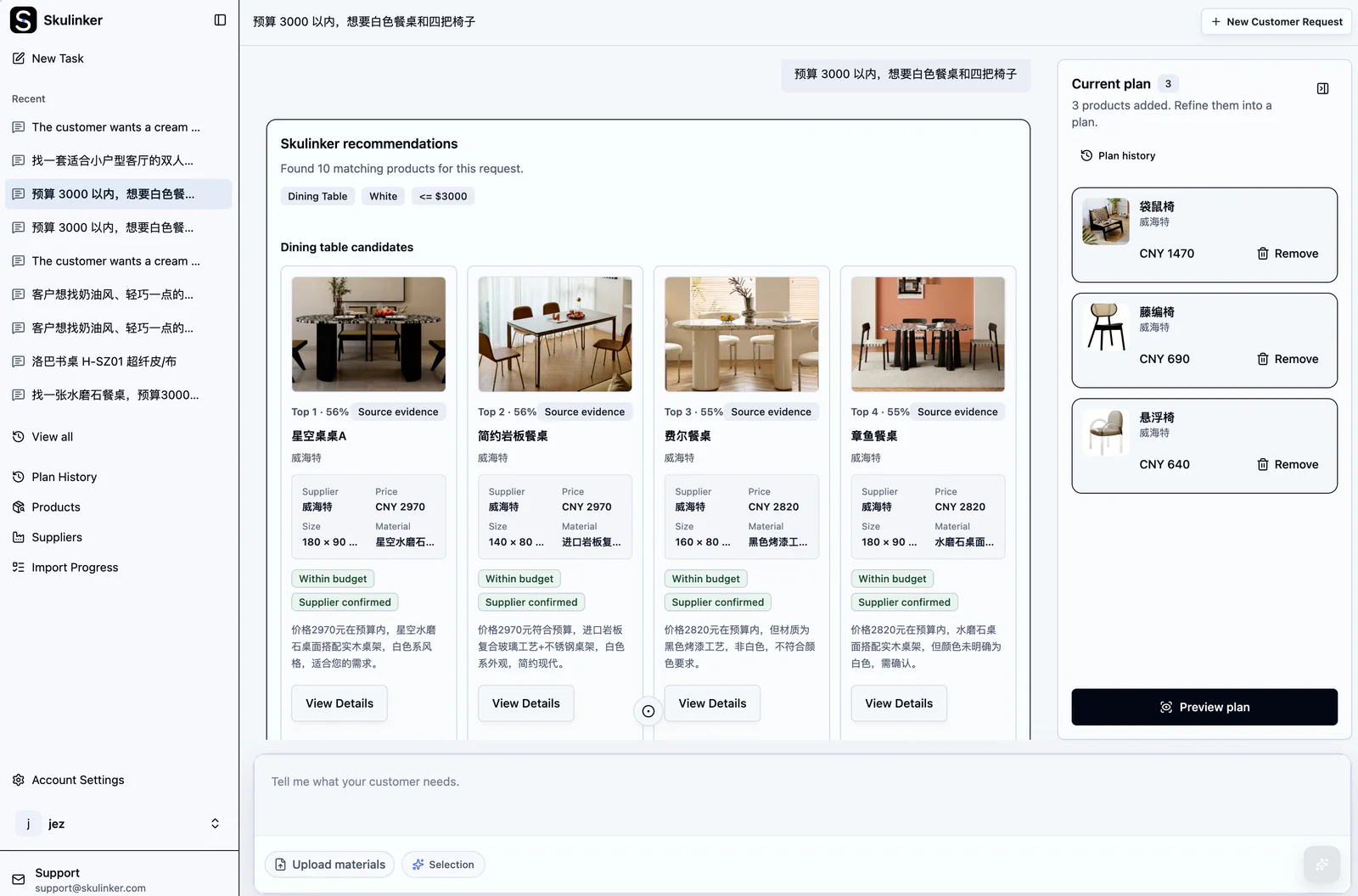
Discovery results can be broad because the user still controls the plan. Identity merges, variant links, and commercial updates require a stricter review path than the ranked substitute candidates shown here.
Interactive Demo in this guide
Review ranked products without hiding uncertainty
The sanitized Demo keeps the sourcing brief, product candidates, supplier evidence, and explicit add-to-plan decision visible.
No sign-up required. Click the input below to try it.
- Describe the space and what you need
- Agent understanding
- Matched from the supplier file
- Details & source
- Add to plan
- Plan preview & export

Human Review Rules for High-Impact Matches
Require human review when a decision would:
- merge product identities or remove a record;
- carry a price, MOQ, lead time, or certification from one record to another;
- change a product-versus-variant relationship;
- assign an image when filenames and source layout disagree;
- map a record into an ERP or other authoritative downstream system;
- create a customer-facing recommendation from conflicting commercial evidence.
The reviewer should see the candidate records, matching signals, conflicts, missing fields, supplier, and source evidence together. Asking someone to confirm a score without its evidence is not meaningful review.
What Product Data Matching Does Not Replace
Product matching does not replace product-master governance, category expertise, supplier confirmation, or downstream approval. It also does not prove that visually similar products have the same materials, construction, certification, price, or lead time.
Skulinker uses supplier product records to support private catalog search and matching, then keeps selected results connected to product and source context. It does not replace complete MDM survivorship, PIM syndication, ERP transactions, or vendor compliance systems.
Frequently Asked Questions
What is the difference between data matching and deduplication?
Data matching identifies possible relationships between records. Deduplication uses those findings to resolve duplicate identities. A matching result can also represent variants, offers, substitutes, or unrelated candidates, so it should not automatically trigger a merge.
Can product images be used for data matching?
Images can help generate or rank candidates, especially when text identifiers are weak. They should be combined with model, dimensions, material, supplier, and source context because visually similar products can still differ in construction, variant, or commercial terms.
Why do precision and recall matter?
Precision measures how many proposed matches are correct; recall measures how many real matches were found. Identity merging usually favors precision, while product discovery can accept broader recall because the user reviews the options before taking action.
When should a person review a match?
Human review is appropriate when evidence conflicts, important fields are missing, or the decision changes identity, commercial terms, images, downstream systems, or customer-facing output. The reviewer should receive the source evidence and reasons, not only a score.
Match Products Without Losing Their Source
Responsible product data matching preserves identity, exposes uncertainty, and adapts thresholds to the action. Skulinker helps teams search and match products from supplier files, review source-connected results, add selected items to a shortlist, and export an editable plan.
Next step
Review the evidence before accepting a match
The Demo keeps the brief, ranked products, supplier evidence and explicit plan decision in one visible workflow.
Continue reading