Vendor management software selection criteria should begin with the record your team cannot manage today. “Vendor management” can mean legal onboarding, bank verification, risk monitoring, contracts, performance, purchasing, or supplier product data. Those categories share a supplier name, but they do not solve the same operational problem.
For a furniture distributor, the bottleneck is often practical: supplier catalogs and price lists arrive in different formats, product images are disconnected from rows, and sales cannot reliably search or compare the resulting information. This guide explains how to evaluate software for that product-data problem without confusing it with a complete supplier-management suite.
Define the Vendor Record and the Product Record Separately
A vendor record answers questions about the organization: legal name, contacts, status, regions served, commercial relationship, and internal owner. A product record answers questions about what the vendor supplies: model, variant, dimensions, material, images, price, MOQ, lead time, and source evidence.
The two records must be linked, but they should not be collapsed. One supplier can provide hundreds of products and multiple versions of the same catalog. A product can also have variants, changing offers, or equivalent alternatives. Software that only stores attachments on a vendor profile has not created a usable product library.
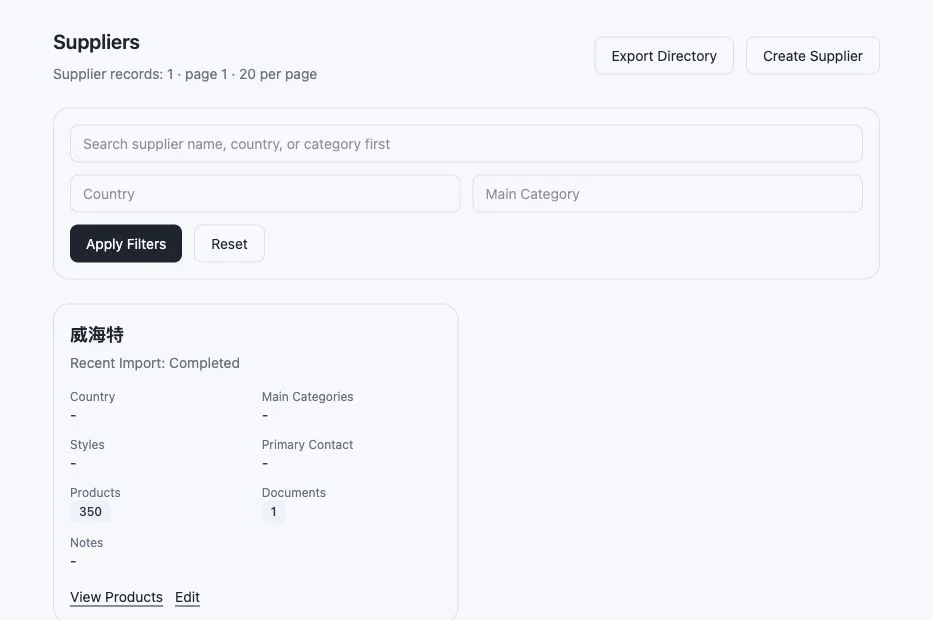
This real Skulinker screen shows the relationship at a useful level: the supplier is visible as a business entity, while product and document counts remain connected to it. It does not represent legal, payment, or compliance approval.
Use a Requirement Matrix by Stakeholder
Ask each stakeholder what decision the software must support, not which feature name they prefer.
| Stakeholder | Decision to support | Evidence to request in a demo |
|---|---|---|
| Product data | Is this record complete and correctly classified? | Field rules, conflicts, source location, review status |
| Sourcing | Which supplier products fit the brief? | Search, filters, comparable attributes, supplier context |
| Sales | Which products can be proposed to the customer? | Images, current commercial data, explicit shortlist |
| Operations | Can an update be processed without duplicate records? | Stable identifiers, change handling, audit trail |
| IT and security | Can the system be operated safely? | Access model, retention, export, integration and recovery details |
| Finance or legal | Is the supplier approved for payment or contracting? | Use the appropriate AP, KYC, risk, or contract system |
This matrix prevents one team’s priorities from silently becoming the definition of the whole project.
Score the Capabilities That Affect Product Data
Weight the criteria before seeing vendor presentations. A furniture distributor might score the following areas:
- Supplier-file intake: actual formats, file sizes, repeated updates, image folders, and error visibility.
- Record modeling: product, variant, supplier offer, asset, and source evidence.
- Extraction quality: candidate fields, units, tables, image links, and explicit uncertainty.
- Review controls: ownership, correction, original values, conflicts, and readiness states.
- Search and matching: category filters and natural-language requests against private reviewed data.
- Selection output: explicit add-to-plan behavior, quantities, supplier details, and editable export.
- Administration: user access, supplier scoping, retention, export control, and recovery.
- Integration: identifiers, data direction, failure handling, monitoring, and system ownership.
Give the highest weight to the steps that consume the most staff time or create the greatest specification risk. Do not let a visually polished dashboard outweigh an unproven supplier-update workflow.
Run a Scripted Demo With Your Own Sample Package
Use the same sanitized supplier package for every candidate: a PDF catalog, a spreadsheet with prices, a small image folder, and one later revision. Include a known ambiguity—such as a unit in the header, a reused image, or several finishes under one model.
Ask the vendor to show, in order:
- how the supplier and files are received;
- how products, variants, images, and offers are separated;
- where a dimension or price came from;
- how a reviewer corrects an uncertain value;
- how the later revision updates rather than duplicates the record;
- how a buyer finds products for a real request;
- how an explicitly selected result reaches an editable output.
Mark every item verified, requires configuration or implementation, or not demonstrated. Capture the source, date, and assumptions for claims that matter to the decision.
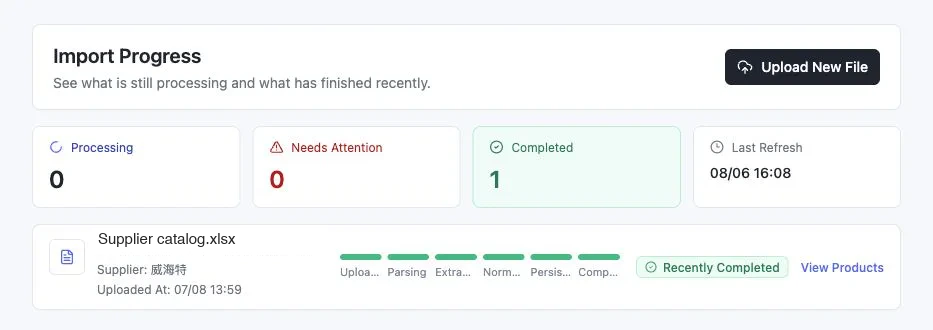
Check the Non-Visual Requirements Separately
A product demonstration rarely proves security, operations, or integration quality. Request written answers for authentication, roles, data isolation, file retention, deletion, backup and recovery, export controls, audit history, support responsibility, and failure escalation.
For integrations, define the source of truth for every important field. “Connects to ERP” is not enough. The team needs to know what moves, in which direction, using which identifier, what happens on conflict, and who notices a failed transfer.
Know When Skulinker Is and Is Not a Fit
Skulinker is relevant when the main requirement is to turn supplier product files into source-connected records, search a private product library, review matches, create a shortlist or selection plan, and export the chosen products.
It is not a replacement for supplier bank verification, tax collection, sanctions screening, ESG monitoring, contract lifecycle management, invoice automation, purchasing, inventory, or financial accounting. If those are the primary requirements, evaluate the corresponding platform first and decide whether a separate product-data layer is still needed.
For the next step, use the supplier-onboarding software evaluation guide, the supplier product data onboarding workflow, and the PIM best-practice guide.
Next step
Evaluate the product-data layer with one real package
Check intake, source evidence, search and export separately from AP, KYC, risk and contract requirements.
Continue reading