What is EDI in practical terms? It is electronic data interchange: a business-to-business method for exchanging structured documents between computers under agreed rules. Within a furniture supply chain, EDI can connect buyers, distributors, suppliers, warehouses, and carriers, but it does not correct unclear product identities or commercial terms. Those records need owners and evidence before onboarding.
What Is EDI?
EDI uses standardized, computer-to-computer business documents instead of asking people to rekey every purchase order or invoice. Partners agree on a standard, document scope, required fields, identifiers, and validation rules. IBM's EDI overview explains that the method replaces paper-based exchanges with electronic messages. That is broader than emailing a spreadsheet: the receiving system must interpret a predictable structure. The partner agreement, not the technology alone, assigns accountability.
What EDI Means in Furniture B2B Trade
A buyer may place an order with a distributor, which coordinates a supplier, warehouse, and carrier. Each party needs the same supplier code, item identity, unit, quantity, date, and location context. Furniture EDI works only when those meanings remain consistent across organizations. Before choosing software, map who creates each document, who accepts it, which system owns the status, and who resolves an exception.
Purchase Order, Acknowledgment, ASN, and Invoice Flow
A typical flow begins when the buyer issues a purchase order. The receiving partner validates it and returns an acknowledgment that accepts, rejects, or proposes changes. Before dispatch, an advance ship notice (ASN) describes the expected shipment, packaging, quantities, and references. After the agreed billing event, the supplier sends an invoice linked to the order and shipment. The parties must define timing, required fields, tolerances, duplicate handling, and rejection rules. Document names do not prove that two partners implement the same fields, so validate each partner specification without assuming transaction codes. During each agreed reconciliation period, compare sent, accepted, rejected, and corrected document counts. When reconciling item quantities, compare the line quantities across the purchase order, acknowledgment, ASN, and invoice separately.
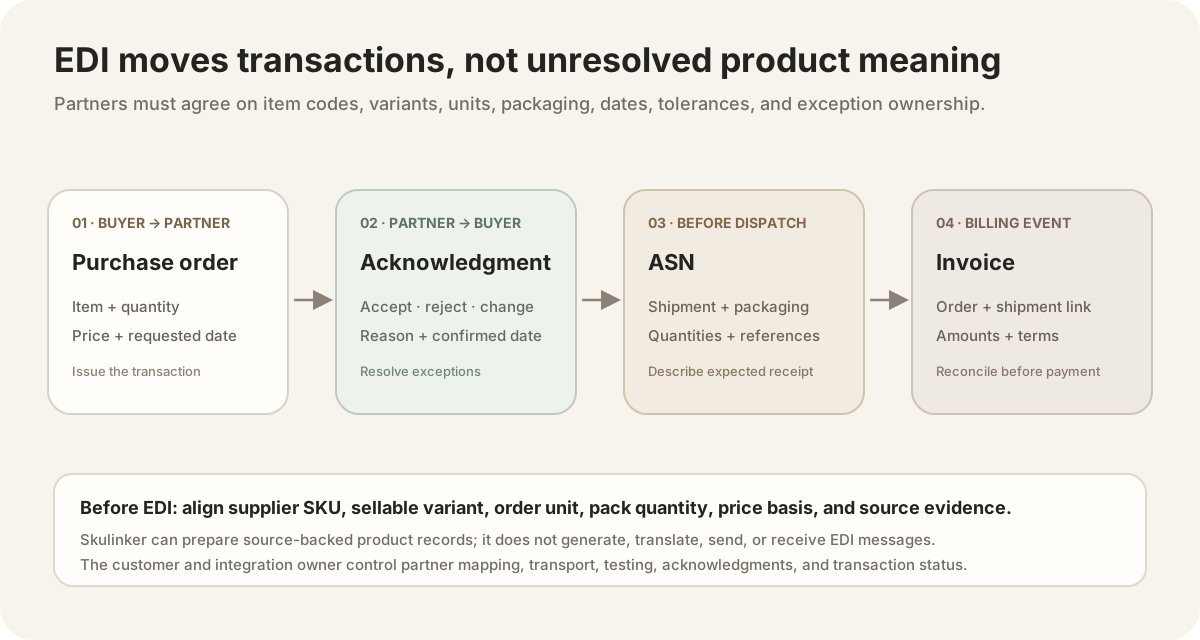
Product identity, sellable variants, order units, packaging, and price basis must be aligned before these transaction messages can be tested safely.

Editorial illustration — a visual explanation of an EDI shipment flow, not a real customer record or product interface.
EDI vs API vs Supplier Portal vs Spreadsheet
These methods can coexist. IBM's EDI and ERP integration guide describes several EDI–ERP integration patterns; the right choice still depends on partner readiness and operational ownership.
| Method | Format and automation | Setup responsibility | Best partner fit |
|---|---|---|---|
| EDI | Standard messages; repeatable processing | Partner rules, mapping, and testing | Recurring B2B document exchange |
| API | Defined request and response interfaces | Endpoint security and maintenance | Partners supporting the same integration |
| Supplier portal | Human entry into a controlled form | Portal owner and user training | Lower-volume partners |
| Spreadsheet | Flexible file with manual review | Version, columns, and exception owner | Early pilots and irregular exchange |
X12 and UN/EDIFACT Basics
X12 publishes standards widely used in North American business exchanges. The UNECE executive guide introduces UN/EDIFACT, a United Nations standard used across international trade. A partner's geography, industry practice, customer mandate, and implementation guide should determine the required standard. The names are not interchangeable implementations: do not promise automatic translation merely because both structure business messages. Treat the implementation guide, directory release, and partner version as controlled parts of the binding partner contract.
Product Master Data vs Transactional EDI Documents
Product master data describes relatively stable facts such as supplier SKU, model, category, dimensions, material, finish, and order unit. Transactional documents describe events: an order, acknowledgment, shipment, receipt context, or invoice. Clean master data helps a transaction reference the intended item, but it does not replace the transaction. Version and ownership matter equally for both layers. Review the ERP data preparation guide and product master data guide when defining that handoff.
Furniture Variants, Packaging, Lead Time, and Supplier Code Risks
The largest risks hide behind apparently valid fields. A sofa model may branch by size, fabric, finish, or configuration, so identity must include the sellable variant. “One” may mean each, carton, or set; packaging levels need quantities and dimensions. Lead time needs an owner, basis, and confirmation date rather than a copied number. Buyer and supplier codes require a governed crosswalk. Record who approved every crosswalk change and when. Preserve the source page, sheet, cell, or image for disputed values. The supplier master data practices and data quality guide offer supporting controls.
Furniture EDI Readiness Checklist
The downloadable checklist covers 12 decisions: partner scope, document scope, identifiers, units, packaging, price, lead time, mapping, transport ownership, testing, exceptions, and accountable ownership. Complete it with procurement, operations, IT, finance, warehouse, and an internal or external integration or transport owner. Attach evidence rather than marking a vague yes. Use the furniture ERP guide to keep operational-system responsibilities visible.
Download the Furniture EDI Readiness Checklist
Where Skulinker Fits Before EDI Onboarding
Skulinker prepares supplier product and master data with source evidence for review, search, matching, shortlist, and export. Skulinker does not generate or translate X12 or UN/EDIFACT messages. Skulinker does not send or receive EDI documents. Skulinker does not write back transaction status. Skulinker does not provide VAN, AS2, SFTP, API transport, or trading-partner onboarding. It is not an EDI service; customers and their internal or external integration owners manage message mapping, secure exchange, testing, and receipts.
EDI FAQ
What is EDI used for in furniture distribution?
It supports repeatable business-document exchange between agreed partners; the precise documents and rules depend on each relationship.
Does an EDI standard fix poor product data?
No. Partners still need aligned item codes, variants, units, packaging, prices, dates, and evidence.
What should a distributor do first?
Choose one partner and document flow, complete the checklist, resolve ownership gaps, and test representative exceptions before scaling.
Conclusion
Good onboarding starts with shared meanings, documented evidence, and accountable exception handling. Download the checklist and validate one realistic flow before scaling partner onboarding.
Next step
Fix product meaning before automating business documents
Resolve item identity, variants, units and evidence before an EDI owner maps and tests the transaction flow.
Continue reading