
Furniture Procurement Process: A Practical Checklist
A furniture procurement process starts with a requirement someone can explain and ends with people checking that the agreed furniture arrived as expected. Keep product details, quantities, prices, and decisions traceable. Skulinker supports the supplier-information and selection stages: source files become structured product records for review, private-library selection, shortlists, and export.
Use the checklist below to move one small project through the handoffs before applying it to a larger order. Furniture procurement also includes approvals, purchasing, delivery coordination, and receipt checks performed by your team and suppliers. Assign those furniture procurement responsibilities explicitly.
Give the furniture procurement process an owner
Name the person responsible for coordinating the work, then identify who confirms requirements, reviews product suitability, approves spending, places the order, and receives delivery. Each furniture procurement decision needs an owner.
Record a project reference and a place for the agreed documents. Keep the furniture procurement workflow traceable across the room brief, selected finish, and final offer.
Record changes during the furniture procurement process. A new quantity, finish, or destination may require review. Date decisions and identify the current version.
View full size
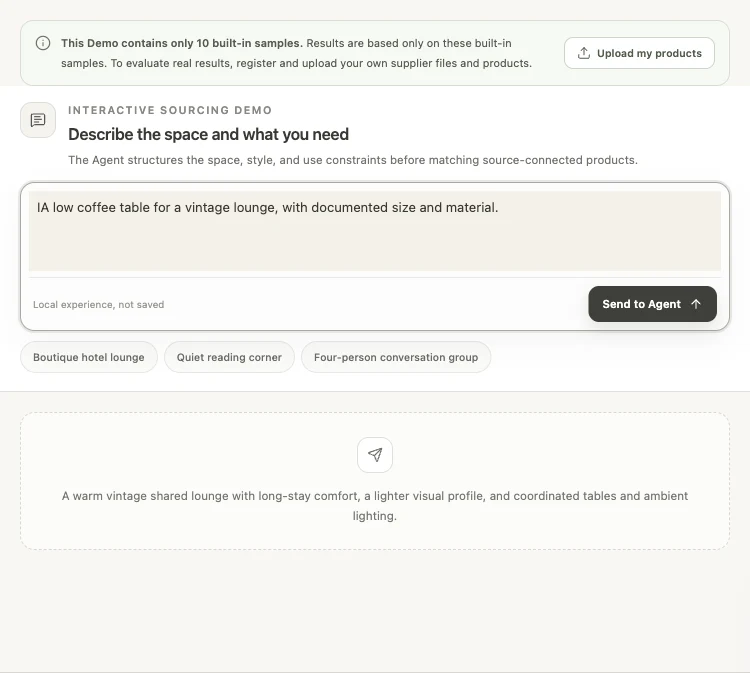
The requirement stage of the furniture procurement process, shown in the homepage Demo. Only built-in sanitized samples are used in this illustration.
Stage 1: define the requirement
The furniture procurement process needs a practical brief before supplier comparison begins. Describe the rooms, intended uses, required quantities, dimensional limits, material preferences, and any budget or timing constraints supplied by the project owner. Mark unknown details as questions.
Use a furniture schedule to connect items with rooms. Confirm whether counts refer to pieces or sets and which revision supports them. A requirement for eight seats does not identify a particular chair, table size, or acceptable layout by itself.
Checkpoint: the requester can explain the essential requirements. Keep optional preferences distinct during the furniture procurement process.
Stage 2: organize supplier information
Good furniture procurement depends on product details that can be checked. Gather the supplier's catalogs, Excel files, PDFs, images, specifications, and quotations. Preserve the originals and note their dates. A current photograph does not prove that an older price still applies.
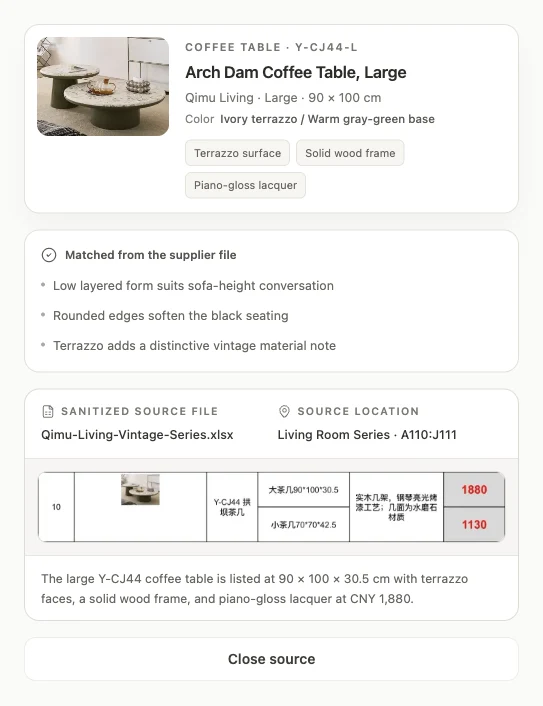
At this point in the furniture procurement process, Skulinker can help turn supplier documents into structured product records for review. Check the extracted identifiers, dimensions, materials, images, and prices against the source where those details matter to selection.
Checkpoint: each candidate has enough confirmed information to evaluate the requirement, with unresolved fields visible. Product information does not establish supplier qualifications, financial standing, capacity, or compliance. Assign any required supplier checks to the responsible people separately.
View full size
Source review in the furniture procurement process. This furniture procurement workflow screenshot preserves the sanitized original supplier document and its source location.
Stage 3: compare equivalent candidates
Build a furniture procurement shortlist against the same requirement. Compare the selected variant, dimensions, materials, quantity basis, quoted price, and confirmed commercial assumptions. Use a supplier comparison template to record differences and questions.
The furniture procurement workflow should retain reasons for exclusions. “Too wide for the stated space” is more useful than “not suitable.” If a lower-priced alternative lacks a confirmed finish or freight basis, resolve the missing detail before presenting it as directly comparable.
Checkpoint: the reviewer can trace each shortlisted product to its source information and understand the tradeoffs. Skulinker supports private-library selection, shortlists, and export for this discussion; the team makes the selection decision.
View full size
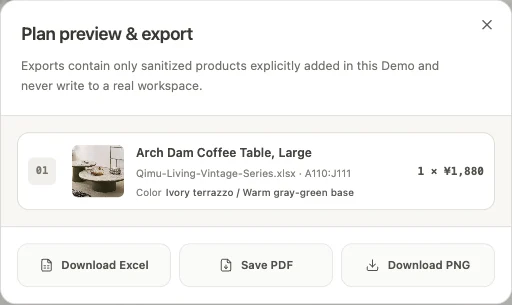
The selection handoff in the furniture procurement process. Explicitly added samples appear in the Demo plan; furniture procurement ordering still requires your team’s procedure.
Stage 4: confirm the offer and obtain approval
Before the furniture procurement process moves to an order, request a confirmed offer for the exact selected models, configurations, and quantities. Check currency, unit basis, applicable taxes, freight, installation, validity, exclusions, and supplier-stated timing with the relevant parties.
A furniture quotation format helps lay out item quantities and unit prices. Treat its arithmetic separately from commercial agreement. A correct line total does not prove that delivery or assembly is included.
Checkpoint: the authorized person reviews the complete offer and records the decision using your organization's procedure. Furniture procurement approvals happen through that procedure; this guide and Skulinker do not supply an approval system or determine your legal obligations.
Stage 5: order, coordinate, and receive
The furniture procurement process continues after a shortlist is chosen. The authorized buyer places the order through the agreed channel, obtains supplier confirmation, and checks that the acknowledged model, finish, quantity, and commercial terms match the approved offer.
Coordinate delivery access, receiving contacts, packaging, assembly responsibilities, and any agreed installation arrangements directly with the supplier and site team. Ask for confirmation of timing instead of treating a catalog lead-time note as a delivery commitment.
Checkpoint: the receiving person compares the shipment with the agreed order, records discrepancies or visible damage, and follows the applicable supplier and organizational procedures. Payment, returns, acceptance, and dispute decisions belong to the responsible parties.
A fictional handoff to test the method
Consider a fictional studio buying six meeting chairs and one table. The requester confirms the room and quantity, a reviewer checks dimensions and finish, and a coordinator collects two supplier offers. These roles illustrate a method, not a real customer case.
During the furniture procurement process, one offer quotes chairs per carton of two while the other quotes per piece. The coordinator clarifies the unit before comparing amounts. The approver then reviews the confirmed offer, and the buyer places the order outside Skulinker.
At receipt, the site contact counts six chairs and checks the table identifier. One chair has a visible upholstery defect. They record the observation and contact the supplier under the agreed procedure. The furniture procurement record should preserve that issue separately from the earlier selection decision.
Furniture procurement process handoff checklist
| Handoff | Evidence to have ready | Person to confirm |
|---|---|---|
| Requirement to selection | Room list, quantities, constraints | Requester |
| Supplier files to comparison | Identified variants and open questions | Product reviewer |
| Comparison to approval | Equivalent offers and stated assumptions | Authorized approver |
| Approval to order | Agreed items, terms, and decision record | Buyer |
| Order to receipt | Supplier confirmation and receiving plan | Buyer and receiver |
| Receipt to follow-up | Count, condition notes, discrepancies | Responsible site contact |
Review the furniture procurement process at each handoff. An unanswered question should have an owner and a next action, rather than disappearing into a shared folder.
Furniture procurement process questions
Does this replace a purchasing system?
No. The furniture procurement workflow describes responsibilities and document checks. Ordering, approvals, payments, stock movements, and delivery coordination need the appropriate people and systems.
Can I begin with existing supplier files?
Yes. Keep the originals, identify the required products, and review the information before comparing candidates. You do not need to retype every catalog into a new template first.
Where does Skulinker help?
Skulinker supports supplier documents, structured product records, private-library selection, shortlists, and export. Explore the Demo on the Skulinker homepage. Current service availability is shown there. Follow your team's agreed procedure for purchasing and delivery.
Next step
See the supplier-file workflow in the Skulinker Demo
Explore how supplier files connect to product records, source review, selection, and export. Check the homepage for current service availability.
Continue reading